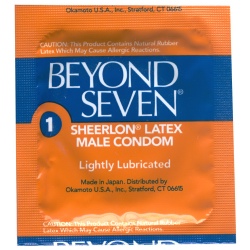
Beyond Seven Condoms. Image from UndercoverCondoms.com
Beyond Seven is the fourth largest condom brand in the world and has been around since 1937 starting in Tokyo, Japan. Standard latex condoms are typically .007 inches thick- but the “Sheerlon” latex of Beyond Seven can measure as thin as .004 thickness, offering one of the thinnest condoms (if not the thinnest!) on the market. These condoms tend to have a standard width of 2.0 inches (measuring the condom laying flat) and to be on the slightly shorter side of standard regular condoms (see our guide on standardized condom sizes). These condoms are perfect if you prefer a snug and thin fit. The best thing to do is experiment with different styles to find the right condom for you. Afflitate links within.
For a comparative search of condom sizes, try our condom size calculator. If you want to compare Beyond Seven against other brands by width, length, and material, use the full condom size chart. Quick Tip! To find the condom width that fits, divide penis circumference by 2.25. Here is how we got this formula.
Zero Zero Four measures the success this condom trumps as being the thinnest condom on the market! Where standard latext condoms are .007, Beyond7 is .004 thickness.
Base width: 2.0”/51mm
Length: 7.2”/180mm
The thinnest condom makers also offer studded condoms for those who love extra stimulation.
Studded along the shaft
Base width: 2.0”/51mm
Length: 7.2”/180mm
Perfect those who want to try all that’s offered from Beyond Seven. This sampler contains 24 condoms including Ultra Thins, Crown, Crown .004, Aloe Enriched, Studded, and Assorted Colors.
————————–
If you are experiencing specific condom fitting problems, check out our fitting solutions guide. Or you can leave a comment below and we’ll help you out.
Our size charts constantly updated, so please join our Facebook, Twitter or RSS feed to keep informed.
This site contains affiliate links. When you purchase products through these links, we may earn a commission at no additional cost to you. These commissions help support our work in providing comprehensive sexual health information. We carefully select our affiliate partners and only recommend products we believe will be valuable to our readers. While we may receive compensation for purchases made through these links, this does not influence our reviews or recommendations. All opinions expressed are our own.
Condom Size Chart: Compare 158 Condoms by Width, Length, Shape & Material
Finding the right condom size matters more than most people think. A condom that fits well is more comfortable, more reliable, and more likely to actually get used. A condom that’s too tight can break or feel uncomfortable. Too loose, and it can slip off. Either way, the experience suffers — and so does safety.
This condom size chart covers 158 individual condoms available from Condomania, one of the most trusted independent condom retailers. Every product listed includes verified dimensions, material, shape, and a direct purchase link.
Bonus: if you’re ordering from Condomania, use coupon code CONDOMMONOLOGUES for 10% off where applicable.
The Complete Condom Size Chart
Start with your fit problem.If you are not sure, use the Condom Size Calculator, then compare the closest products below. Use coupon code CONDOMMONOLOGUES at Condomania where applicable.
Brand: Unique Condoms Width: 50 mm / 1.97 in Length: 6.29 in / 160 mm Thickness: 0.015 mm Notes: Lubricated, Ultra Thin, Vegan Buy at Condomania
How Condom Sizes Work
Most people think condom size is about length. It usually isn’t. In real life, the most important measurement for fit is nominal width — the flat width of the condom when laid flat, usually measured in millimeters.
Why does width matter so much? Because width determines how tight or loose the condom feels around your shaft. A condom that is only a few millimeters too small can feel uncomfortably tight. A condom that is a few millimeters too large can bunch up, slip, or feel insecure.
Length still matters, especially if you find condoms too short or if you have a lot of excess roll at the base. But for most people, girth fit matters more than length fit.
What is nominal width?
Nominal width is the standard sizing measure used to compare condoms. If you laid a condom flat and measured it straight across, that measurement would be its nominal width. That’s the number you see in millimeters, like 49 mm, 53 mm, 56 mm, or 60 mm.
As a rough guide:
Small / Snug = under 50 mm
Medium / Standard = 50–54 mm
Large = 55–57 mm
XL = 58 mm and up
Those categories are useful for browsing, but always remember that the exact millimeter width is more important than the marketing word on the box.
How to Measure for a Better Condom Fit
If you want a condom that actually feels right, measure first. You only really need two numbers:
Girth (circumference) — Wrap a soft tape measure or strip of paper around the thickest part of your erect penis.
Length — Measure from the base to the tip along the top side.
For condom fit, girth is the priority. If you know your circumference, you can estimate your ideal condom width much more accurately than by just guessing what sounds “normal” or “large.”
Quick rule of thumb
A lot of people use a simple fit shortcut: divide your erect girth by about 2.25. That gives you a rough target range for condom width.
Want the chart translated into a pick? Use the condom sizing guide for the full girth-to-width walkthrough. If latex-free material is part of the decision, compare non-latex condoms by size and fit before choosing a brand.
Why the Right Fit Matters
Too tight — can feel restrictive, reduce sensation, and increase breakage risk.
Too loose — can slip, bunch, or feel less secure.
Good fit — feels comfortable, stays in place, and improves confidence.
If condoms have always felt annoying, there is a decent chance you simply haven’t been wearing the right size or shape.
Shape Matters Too
Fit isn’t only about width. Shape changes how a condom feels during sex.
Straight — same basic width from base to tip.
Flared — more room at the head, often more comfortable for people who feel constricted at the tip.
Contoured / Comfort Fit — shaped for a more anatomical fit.
Snug Fit — narrower overall for a tighter feel.
Pleasure Shaped — often textured or specially shaped for extra stimulation.
That’s why two condoms with the same nominal width can still feel different. One might feel perfect, and another might feel weird, even if the width number matches.
Condom Materials Explained
The chart includes multiple materials because not everyone wants or can use standard latex condoms.
Latex — the most common, stretchy, effective, and widely available.
Polyisoprene — latex-free, softer feel, popular in products like SKYN.
Polyurethane — thinner feel, less stretchy than latex.
Nitrile — newer non-latex option with good heat transfer.
Lambskin / natural membrane — very different feel, but not appropriate for STI protection.
Those pages go deeper on the specific shapes, materials, and quirks of each brand. They’re useful if you want to compare within one brand before trying something new.
No. “Standard” is not a strict technical size. Many standard condoms fall in the 52–54 mm range, but shape and length still vary.
Are Magnum condoms really huge?
Not always. Many condoms marketed as “large” are only slightly wider than standard condoms. That’s why exact width matters more than branding.
What if I need a smaller condom?
Look at products under 50 mm nominal width. You can also use the calculator and our fit guides to identify snugger options.
What if I need a non-latex large condom?
Use the chart filters to combine Large or XL with Non-Latex. That’s one of the quickest ways to find realistic options.
About This Chart
This chart is designed to make condom shopping less confusing and more useful. We combine brand information, retailer data, and independent fit-focused organization into a single searchable table.
All purchase links on this page go to Condomania. If you order there, remember to try coupon code CONDOMMONOLOGUES for 10% off where applicable.
This site contains affiliate links. When you purchase products through these links, we may earn a commission at no additional cost to you. These commissions help support our work in providing comprehensive sexual health information. We carefully select our affiliate partners and only recommend products we believe will be valuable to our readers. While we may receive compensation for purchases made through these links, this does not influence our reviews or recommendations. All opinions expressed are our own.