Image source from http://www.productreview.com.au/p/ansell-lifestyles-ultra-thin.html
Note: We bought these in New Zealand, but in North America they have blue colored packaging.
This is a great condom. Generally, I find Lifestyles tend to be a bit tight around the ring and difficult to roll down to the base. But the Micro-Thin fits like a (G)love! It unrolls ease every time with just the right amount of stretch so there is not a lot of time spent making sure it’s on correctly. And no complaints in the sensitivity dept. I give the condom a 4 out of 5. The only reason it doesn’t hit top spot is because it has that slight latex scent that I dislike, which makes my want to try the polyisoprene version.
Laying flat, it’s measurements are
Length: 7.6in/193mm
Base width: 2.0in/50.8mm (this condom has the same width from the ring up until the reservoir tip).
(This is not a product endorsement! While some of our links are affiliate links that earn us a small commission, Condom Monologues is an independent, grassroots collective and we do not favor on brand or product for profit).
This site contains affiliate links. When you purchase products through these links, we may earn a commission at no additional cost to you. These commissions help support our work in providing comprehensive sexual health information. We carefully select our affiliate partners and only recommend products we believe will be valuable to our readers. While we may receive compensation for purchases made through these links, this does not influence our reviews or recommendations. All opinions expressed are our own.
Image source from http://www.productreview.com.au/p/ansell-lifestyles-ultra-thin.html
Note: We bought these in New Zealand, but in North America they have blue colored packaging.
This is a great condom. Generally, I find Lifestyles tend to be a bit tight around the ring and difficult to roll down to the base. But the Micro-Thin fits like a (G)love! It unrolls ease every time with just the right amount of stretch so there is not a lot of time spent making sure it’s on correctly. And no complaints in the sensitivity dept. I give the condom a 4 out of 5. The only reason it doesn’t hit top spot is because it has that slight latex scent that I dislike, which makes my want to try the polyisoprene version.
Laying flat, it’s measurements are
Length: 7.6in/193mm
Base width: 2.0in/50.8mm (this condom has the same width from the ring up until the reservoir tip).
(This is not a product endorsement! While some of our links are affiliate links that earn us a small commission, Condom Monologues is an independent, grassroots collective and we do not favor on brand or product for profit).
This site contains affiliate links. When you purchase products through these links, we may earn a commission at no additional cost to you. These commissions help support our work in providing comprehensive sexual health information. We carefully select our affiliate partners and only recommend products we believe will be valuable to our readers. While we may receive compensation for purchases made through these links, this does not influence our reviews or recommendations. All opinions expressed are our own.
A recent study by researchers at Stanford Medical School reveals that a large portion of young women are irresponsible in bed, meaning they ain’t protecting themselves. The year-long study collected data from 1,194 sexually active females aged 15 to 24 who visited Planned Parenthood clinics and were beginning contraceptive pills, patches, injections, or vaginal rings for the first time. At the beginning of the study, only 36 percent of participants consistently used the “dual method” (relying on both hormonal contraceptives and the condom), which meant that STI and STD protection was compromised. Getting pregnant seems to be the only risk to care about.
Surprised? To be honest, I wasn’t either as I know many friends whose first time using birth control was when they entered a relationship with someone they trust, and that trust included believing (hopefully, with medical proof) that neither person carried STIs.
However, it gets worse: The study found that over 50 percent of young women did not resume condom use after they discontinued hormonal contraceptives. That’s right, NO protection!
Less Youth are Using Condoms
Why is this happening? And how can prevention improve? According to Rachel Goldstein M.D., lead author of the study, the most influential factor of condom usage is the partner’s attitude toward condoms. When a woman did not know how her partner felt about condoms or knew that he felt they were “very important”, she was more likely to be a dual method user than when her partner thought condoms were “not at all important”. The researchers speculate that power imbalances within the relationship impact the woman’s ability to negotiate condom use. “It appears that her partner’s feelings may be more important than her perceived risk of a sexually transmitted infection or her own beliefs about dual method use,” said Goldstein. This is an important point of concern. There are many factors, including levels of mutual respect, emotional maturity, and self-esteem that need to be considered when counseling youth about healthy sex (Scarleteen offers great advice on negotiating condom use). Of course, the study concludes that more counseling is needed to accompany hormonal contraceptive treatment that emphasizes the risks of STIs and STDs.
However, I think this is only one piece in the very complicated puzzle of sexual relations. Plus, the research does not address why young women are not resuming condom use after discontinuing hormonal medication.
In fact, condoms are not very popular among young adults in general. According to the American Academy of Pediatrics and the Henry J. Kaiser Family Foundation, the rate of STIs in people 15-24 years old is exceptionally high. Two-thirds of all individuals who become infected with STIs in the United States are younger than 25 years old! The reason for this is because young people simply are not using condoms and other barriers consistently or correctly to protect themselves and their partners.
Condoms Miss the Limelight
Now, most teens in North America have been exposed to sex ed and know why condoms exist, but this is obviously not the only means to ensuring healthy sex lives. Indeed, sex pedagogy in North America is riddled with censorship (that’s a whole other post), and health counseling should accompany hormonal contraceptive use. Both these solutions, however, overlook a larger social problem. The social stigma which has developed around STIs and diseases has produced negative attitudes and ignorance towards safer sex. It’s fair to say that this negativity permeates in our popular culture.
Condoms and other safer sex practices have acquired an unsexy reputation from their very absence in romantic and steamy and sex positive representations. Pornography, films, romance novels, or how-to articles in popular magazines rarely represent the condom and how it can actually increase sensuality, not dull it. And this is something that needs to change because it limits our knowledge, attitude and imagination about what healthy sex can be.
This is not to say that viewers of media are passive recipients who are easily influenced by what is on TV. But media can be interpreted as a cultural artifact that reflects beliefs, attitudes, prejudices of the times. It is a matter of what sells, and unfortunately, the mainstream only works to reinforce the notion that safer sex is a chore.
One Solution: Safer Sex Porn!
There are some who have sought to exert control over the representation of safer sex through alternative media. One honorable example is the 1990 video short, Current Flow, by Jean Carlomusto starring Annie Sprinkle and Joy Brown. This explicit video was made in response to Cosmopolitan magazine publishing a piece which erroneously claimed that virtually no females could contract HIV. The short is basically about a woman (Annie Sprinkle) masturbating on the couch with her vibrator. Suddenly her vibrator stops and we see a woman enter the room with a towel in one hand and a power cord in the other (not many battery-operated vibrators back then). The woman seductively crawls over Annie and rolls out from her towel dental dams, latex gloves, condoms and lube for the dildo. And the climax begins.
But this is not just any girl-on-girl porn, it also emphasizes “showing how”. For example, a close-up of Annie Sprinkle getting eaten-out shows how to use a dental dam. Another shot shows Joy Brown washing the dildo before it is her turn to use it on Annie. As Carlomusto writes,
“…in order to educate lesbians about safer sex we have to establish what it is. Saying, ‘use a dental dam’ is not the same as saying ‘use a condom’, since many women don’t know what a dental dam is” (1992: 82).
Current Flow is the first of it’s kind. Sexy and safe lesbian porn made by and for lesbians. It was made at a particular time during the HIV/AIDS crisis when the Centers for Disease Control refused to investigate data on woman-to-woman transmission of HIV. It was also a time when mass media and public health bureaucracies refused to produce explicit sex education or represent gay and lesbian sexuality. While the information today is made more available and inclusive of a wider public, we still do not see safe sex represented as often as we see sex in the media.
Safer sex should be not be limited to public health messages or HIV/AIDS activism. What would be powerful is normalization of safer sex in everyday media. Imagine music videos- the soft porn of daytime television- including condoms in a sexy, bootylicious way…
Dull Feeling in Bed Begins with Dull Attitude
You might think that the reason there are few representations of positive condoms in popular culture is simply because condoms are genuinely unfun and decrease pleasure. You might think that it is for this reason that younger people are using condoms less. I would argue that this belief is grounded more in attitude than it is in actual reality. Let me explain.
Some studies, such as “Sexual Pleasure and Condom Use” by Randolph et. al. (2007), have found that those who report sex with a condom as less pleasurable tend to be people who have not used condoms in a while or who don’t use them at all. They found that more men than women tend to believe condom use is less pleasurable even without actual experience. It is beliefs that influence experience with condoms and whether one wants to use them. It is true that many people reported that unprotected sex feels better than protected sex. Overall, people who are familiar with using condoms tend to report greater pleasure with protected sex than those who are likely to go without protection. As Heather Corinna at Scarleteen writes, “The more you use them, the more they feel good, and it’s people who don’t use them at all that tend to complain about them most.”
In other words, it is the attitude that one has towards condoms that greatly affects satisfaction. People who use condoms often do not express a decrease in overall pleasure because they learn what condoms suit them best and what ways they are most comfortable using them.
Know Your Condom
Which brings me to my next point. Part of the process of popularizing condoms is to increase understanding of the different types and ways of using them. Another study by Michael Reece and Debra Herbenick (2012) found that many people do not know how to use condoms properly and what can increase pleasure. For example, putting a drop of lube inside the condom before rolling it on can improve application and increase sensitivity. Also, the condom can be put on in sexy and tantalizing ways by you or your partner that make it a part of sex- not an interruption to it. Check out our post for some sexy tips on condom use.
Pediatrics and sex educators should know condoms too. Reece and Herbenick suggests that prevention providers can play a valuable role in alleviating negative perceptions of condoms by recommending different condoms made for specific needs. For example, for those men who feel condoms are too tight, a practitioner may recommend condoms which are designed with a more bulbous head or looser fit. The point is that there are hundreds of thousands of condom types out there and there needs to be more access and understating of choice and care.
If it’s true that sexual pleasure with a condom is all in the attitude than it is all the more important that there be representations of safe sex in pop media. How powerful would it be if Jake Gyllenhaal whipped out a condom during the famous sex scene in Broke Back Mountain!
What do you think? Would safer sex in the media help increase positive attitudes towards safe practices? What do you think should be done to get more youth practicing safer sex?
Source cited: Jean Carlomusto & Gregg Bordowitz (1992).“Do It! Safe Sex Porn for Girls and Boys Comes of Age.” A Leap in the Dark: AIDS, Arts and Contemporary Cultures. Allan Klusacek & Ken Morrison, eds. Montreal: Vehicule Press.
This site contains affiliate links. When you purchase products through these links, we may earn a commission at no additional cost to you. These commissions help support our work in providing comprehensive sexual health information. We carefully select our affiliate partners and only recommend products we believe will be valuable to our readers. While we may receive compensation for purchases made through these links, this does not influence our reviews or recommendations. All opinions expressed are our own.
We’ve received requests for more info about condoms that are made specifically for oral sex, as well as other safer oral sex methods. Indeed, the know-how in this area is not as wide known as it should be. People are less likely to protect themselves during oral sex…even among those cautious sexers who use condoms consistently. Perhaps this is because some do not consider oral sex to be “real sex” and thus think it’s less risky. But the fact is that oral sex is sex (some prefer it to genital sex) and many diseases and infections you can catch or transmit through intercourse you can also get through oral sex, regardless of whether you swallow or not. As one of our readers pointed out, HPV (the most common STI in the USA today) is often transmitted during oral sex (these are some good sources for more info on HPV: HPV Awakening, Scarleteen, SEX,etc.). So in this post we go through safer oral sex practices and how to find the right method for yourself.
To reduce the risk of STIs, you can use latex or non-latex barriers. For fellatio (oral sex with penis) use a condom. For cunnilingus and analingus use dental dams, latex or nitrile gloves, or plastic wrap (but remember, not the microwaveable wrap!).
Fellatio and Condoms Options
A condom for safe oral sex can be perfectly satisfying should the right condom be used according to your tastes and needs. First of all, do not use condoms or lubricants made with spermicide, such as nonoxynol-9 which can numb your tongue. And do not use any condoms designed to “extend” male performance, such as Trojan’s Extended Pleasure, as these are made with not-so-tasty benzocaine that will leave an unpleasant sensation in your mouth. Choose condoms that are water-based (most condoms are) or choose a non-lubricated condom.
For those who do not like the taste of latex or have a latex allergy, there are many non-latex options on the market made of polyisoprene or polyurethane (lambskin does not protect against STIs so do not use them for oral sex!). These non-latex condoms are virtually odorless and tasteless. However, most non-latex are difficult to buy in stores or pharmacies; but online stocks are varied and plenty.
Flavored condoms or lubricants are also a good option. You can buy multipacks to determine your favorite flavor and there are usually small sample packs of lube available at sex-shops. But be sure to use a lubricant that is compatible with the condom material- oil-based lubes cannot be used with latex or polyisoprene. There are also flavored gel strips, like Masque, which simply dissolves on your tongue like a candy and the flavor lasts for up to 15 minutes.
Dental Dames and Barriers
If you are giving or receiving oral sex from mouth to vulva (outside of vagina) or mouth to anus there are various barrier methods to protect from STIs: Dental dams or making your own barrier from condoms, gloves, or plastic wrap.
A dental dam is a thin rectangle-shaped sheet used for cunnilingus or analingus to protect against sexually transmitted infections during oral sex. Like condoms, dental dams are typically made with latex, polyurethane or polyisoprene. There are flavored dams, colored dams, dams that you hold in place, and non-slip no-hold dams. Unfortunately, dental dams are not as readily accessible in pharmacies and retail stores. This is part of an all too common and dangerous oversight in safe sex inventory. Often female safe sex products or non-penetrative sex products are placed secondary to condoms and are not as easily accessible. This is another advantage to shopping online. Sexual health clinics, such as Planned Parenthood also supply dental dams.
If you and/or your partner are concerned that oral sex will not feel as amazing with a protective barrier, take some advise from Heather Corinna at Scarleteen.com, and put a few drops (not too many!) of lubricant on the genitals of the receiver before putting on the barrier. This will keep the material from sticking and will increase sensitivity and sensation immensely.
Check out this pamphlet for more information about STIs and diseases that the dental dam protects against.
If you find dental dams too tricky to get a hold of or not the right material/shape for you, you should try making a barrier just for you or your partner using a condom or glove.
These are some excellent sources for step-by-step instructions on how to make a dental dam from condoms or gloves: YouShouldKnow.ca, STD.about.com, PAMF.org.
Hopefully this information will help you receive and perform safer oral sex. If you have any further questions or even some extra tips / experiences to share then please leave a comment below.
This site contains affiliate links. When you purchase products through these links, we may earn a commission at no additional cost to you. These commissions help support our work in providing comprehensive sexual health information. We carefully select our affiliate partners and only recommend products we believe will be valuable to our readers. While we may receive compensation for purchases made through these links, this does not influence our reviews or recommendations. All opinions expressed are our own.
Options for non-latex condoms today are increasing and more people are choosing non-latex condoms regardless of latex allergies. This is basically because the latest non-latex options are made of material that is softer, thinner, more elastic than latex rubber. In this post, we explain basic facts about non-latex condoms, such as what the differences are between polyisoprene and polyurethane, and what are the advantages and disadvantages of different non-latex options. All condoms, except Lambskin, have the advantage of protecting against both sexually transmitted infections and unwanted pregnancy. Condoms do not require clinical visits, they do not alter hormones nor have physical side effects. Non-latex condoms are a key solution for those who are sensitive to latex. Options include lambskin, polyurethane and polyisoprene condoms, AT-10 synthetic resin and synthetic nitrile rubber. Lambskin condoms, also known as “natural skin” or “sheepskin”, are one of the oldest methods of birth control. They are made of a thin layer of cecum which is part of the sheep’s intestine. The organic matter provides such intimate sensation that many users consider them the closest thing to not wearing a condom. Lambskin condoms are effective at preventing pregnancy. However, they do not prevent against sexually transmitted bacteria or viral infections, including herpes and HIV. Now that there are other latex alternatives, lambskin may decline in popularity as other non-latex options- like polyurethane and polyisoprene- do provide protection against STIs and pregnancy.
They are expensive; approximately $3.00 each compared to the average Trojan latex condom cost of 0.50 each.
Trojan is the only manufacturer of lambskin condoms in North America.
They are not vegan
The first FDA approved polyurethane condom was Durex Avanti in the 1990s. Compared to latex, polyurethane condoms are thinner and do not have a scent. While very durable, polyurethane is less elastic and snug fitting than latex, making the risk of slippage or breakage higher. Thus lubrication (oil, silicone, or water-base) is highly recommended for penetrative sex. In 2009, Durex started manufacturing polyisoprene condoms instead of polyurethane, now called Avanti Bare Real Feel. Today, Trojan SUPRA is the most popular polyurethane condom on the North American market.
Benefits of Polyurethane
Thinner and less odor than latex
Transmits body heat very well
Can be used with oil, silicon and water-based lubricants
They cost more than latex condoms, but are cheaper than lambskin
Ideal for those who prefer less tight, less body forming fit.
Disadvantages of Polyurethane
They are less elastic and are loose fitting compared to latex, thus increasing the risk of malfunction if no lubricant is used.
They are not biodegradable
Not easily accessible in all drugstores or supermarkets
Polyisoprene came on the market in 2008 by LifeStyles SKYN product line, and soon after Durex re-manufactured Avanti Bare Real Feel with the new material. It is a natural rubber that is chemically similar to latex, but without the latex allergens. In comparison to polyurethane condoms, polyisoprene is softer, more supple and form fitting, and slightly thicker (similar thickness to standard latex). To date, polyisoprene condoms are sold in North America by LifeStyles and Durex.
Advantages of Polyisoprene
Softer, more elastic and form-fitting than both latex and polyurethane.
They transmit heat better than latex
They are cheaper than polyurethane condoms, but not as cheap as latex.
Disadvantages of Polyiosprene
Not biodegradable
Cannot be used with oil-based lubricants
Not made in both male and female form.
Not as readily available in stores; easier to find and buy online.
Nitrile Rubber: FC2 is the most common female condom globally and the only female condom available in North America. In 2009, FC2 began manufacturing with nitrile rubber, which offers the same benefits and protection as polyurethane, but is less expensive to produce. It is also softer and more supple than polyurethane.
Benefits of Nitrile Rubber
Hypo-allergenic
Protects against STIs and pregnancy
Significantly less expensive than other female condoms
Softer, more form-fitting, and supple than polyurethane.
Can use oil, silicon and oil-base lubricants
Disadvantages of Nitrile Rubber
Not biodegradable
2X more expensive than male condoms
Not easily accessible in drugstores and supermarkets
This is a post that will be updated. If you know of other non-latex condom options, please let us know. And don’t be shy to ask any questions or leave comments here.
This site contains affiliate links. When you purchase products through these links, we may earn a commission at no additional cost to you. These commissions help support our work in providing comprehensive sexual health information. We carefully select our affiliate partners and only recommend products we believe will be valuable to our readers. While we may receive compensation for purchases made through these links, this does not influence our reviews or recommendations. All opinions expressed are our own.
Everyone knows the awkwardness of staring at a store shelf of johnnies with so many questions and confusions (it really shouldn’t be awkward!). But not everyone has considered the advantages of buying condoms online. Sure, internet buying does not solve emergency needs. It can take some online orders up to two weeks to arrive. However, in this article, we consider how the advantages of buying online outweigh that of a pharmacy, corner shop, or grocery store.
Some of the external links are affiliate links that earn us a small commission.
Why buy condoms online
1) Privacy.
It is the most discrete way to buy condoms. Period. With no cashier to check through, you do not need to feel shy about what he or she will think when swiping your 12 pack of whatever type and size condom companies print so boldly on the box. No one will see your purchase.
Most condom distributor websites use discrete packaging and billing information. For example, undercovercondoms.com will ship your order in a plain envelop or box. The name on the return address does not reference anything about condoms or sex-related products. Instead it will read an inconspicuous “PCPD LLC”. The credit card bill will also list “PCPD LL” only. You do not need to ask the storekeeper face-to-face personal questions about which studded condom is the most sensitive or which “snug fit” suits your tool. Your needs can be researched and answered online with full anonymity.
2) Price.
Condoms are less expensive online. At a general DUADEreade in the USA, a box of 12latex condoms can range between $14.50 to $16.00. Online, however, a box of 12 can be $6.00 cheaper. For example, you can buy a 12 pack of Trojan Magnum Thins for $7.99. Even the more expensive non-latex condoms, such as Lifestyles SKYN line made of polyiosprene, can be as low as $6.99- which is about 50% less than the standard retail store price.
There also tends to be more deals offered online. Though no one can beat the price of free condoms one picks up at most health clinics or STI prevention centers (such as Planned Parenthood) there are some online deals that offer free sample packs.
3) Variety of selection.
This is arguably the best advantage to online shopping. Unlike a DUADEreade, there is a great trove of choice online as virtually all condom shape, sizes, textures, tastes are available. Those that are typically harder to access in retail stores, such as female condoms, vegan condoms, or non-latex, are easily retrieved online.
You can also find a great number of reviews and recommendations when exploring new brands or condom materials. This includes the advantage of searching for top sellers as well as the more rare, not so common condom types, like lamb skin or polyiosprene.
This service is provided online only. Companies like Coripa.com and TheyFit.co.uk will help you determine your size and recommend a condom for you with a 100% satisfaction guarantee policy. I do not think there are any other stores that would allow you to return a condom if it did not fit well.
What other advantages or disadvantages are there? If you can think of any, or have a relevant experience of buying condoms, please share here.
Confused about how to pick your size? Check out our guide for converting penis circumference to condom width.
This site contains affiliate links. When you purchase products through these links, we may earn a commission at no additional cost to you. These commissions help support our work in providing comprehensive sexual health information. We carefully select our affiliate partners and only recommend products we believe will be valuable to our readers. While we may receive compensation for purchases made through these links, this does not influence our reviews or recommendations. All opinions expressed are our own.
Durex Condom Size Chart: Width, Length, Fit, and Best Durex Options
Quick answer: most Durex condoms are standard-fit condoms around the low-to-mid 50 mm nominal-width range, but Durex also has larger/comfort-fit options and product names vary by country. If you are choosing by fit, start with nominal width, not box wording.
This page is built for the exact searches people use — Durex condom size chart, Durex size chart, Durex size guide, and Durex condom size — so the opening answer stays focused on nominal width, fit, and the current Durex options worth comparing.
Fast read: if your search is for a Durex size guide or Durex condom size chart, start with nominal width. Durex Air Close Fit is the closer 52 mm option in this set, Durex Air Transparent and Extra Sensitive Thin sit around 54 mm, and Avanti Bare or Performax Intense are roomier 56 mm options.
Need a Durex-only shortlist? Use the Durex condom size calculator if your search is really “condom size calculator Durex.” Use the main condom size calculator if you want to compare Durex against SKYN, Trojan, and other brands side by side.
Quick picks
Best Durex condoms to compare first
If you are buying from this Durex chart, start with the fit problem rather than the box name.
Product links go to Condomania. Use coupon code CONDOMMONOLOGUES where applicable.
Durex size guide by fit
Fit need
What to look for
Next step
Snugger fit
Lower nominal width, usually under 50–52 mm
Compare snug options in the calculator
Standard fit
About 52–54 mm nominal width
Most regular Durex options fall here
Roomier / comfort fit
About 55 mm+ or shaped/comfort-fit designs
Compare against Trojan Magnum, SKYN Large, and other large options
Latex-free
Polyisoprene or other non-latex material
Check current availability; product names change by market
How to choose a Durex condom size
What “nominal width” means: it is the width of the condom in millimeters when laid flat, not body girth or circumference. Durex’s own size reference describes its measurements as nominal, lay-flat widths.
Measure erect girth around the widest part with a soft tape or strip of paper.
Keep the units clear: 1 inch = 25.4 mm. Enter your girth in the condom size calculator to get a starting width range.
Compare that range with the Durex options in this chart. Product names and measurements can vary by market, so check the exact nominal width printed on the current package or official product listing before buying.
If you are between sizes, do not guess from “regular,” “large,” or “thin” marketing names alone. Width in millimeters is the useful number.
Durex size FAQ
Are Durex condoms all the same size?
No. Many are standard-fit, but Durex products vary by width, shape, lubricant, texture, material, and market availability.
What Durex size should I use?
Use girth first. Around 4.5–5.0 inches of girth often fits many standard condoms; above that, compare roomier options. If condoms feel tight, leave a ring mark, or reduce sensation, try a wider nominal width.
Is Durex larger or smaller than Trojan?
It depends on the exact product. Compare individual widths, not brands. For Trojan-specific measurements, see the Trojan condom size chart.
Durex fit ranges: what most shoppers need to know
If your search starts with “Durex size chart,” the useful question is how Durex widths break down in practice. Most current Durex options land in one of three buckets:
52 mm: closer-fit Durex options for people who find standard condoms a little loose.
53 to 54 mm: the mainstream Durex range where most regular-fit shoppers land.
56 mm: the roomier Durex range, including the main latex-free and delay-fit options on this page.
That width-first view is more useful than relying on “thin,” “intense,” or “real feel” box names alone. If you already know your girth, confirm the width with the Durex condom size calculator or compare all brands in the main condom size calculator.
How to pick the right Durex condom from this chart
If regular condoms feel loose or bunch up
Start with Durex Air Close Fit. It is the clearest closer-fit Durex option in the current lineup and the best first check when standard 53 to 54 mm condoms do not stay secure.
Compare Durex Avanti Bare Real-Feel and Durex Performax Intense first. They are the roomier 56 mm Durex options in this chart and the quickest check before you size up into broader large-condom families.
If you still are not sure what width range you need, use the condom sizing guide before shopping by brand.
Bottom line
For most people, Durex is a standard-width brand family with a few cleaner fit branches rather than a huge size spread. Start with Air Close Fit at 52 mm if regular condoms feel loose, Air Transparent or Extra Sensitive Thin at 54 mm for a mainstream Durex fit, and Avanti Bare Real-Feel or Performax Intense at 56 mm if you need more room or want the latex-free Durex option first.
This site contains affiliate links. When you purchase products through these links, we may earn a commission at no additional cost to you.
This site contains affiliate links. When you purchase products through these links, we may earn a commission at no additional cost to you. These commissions help support our work in providing comprehensive sexual health information. We carefully select our affiliate partners and only recommend products we believe will be valuable to our readers. While we may receive compensation for purchases made through these links, this does not influence our reviews or recommendations. All opinions expressed are our own.
Trojan Condom Size Chart: Width, Length, Magnum Sizes, and Girth Recommendations
Quick answer: Trojan sells mostly standard and large condoms. Regular Trojan condoms are usually standard-fit; Magnum and Magnum XL are roomier; Trojan does not have many truly snug-fit options. For fit, compare nominal width in millimeters and your girth, not just the word “Magnum.”
Compare nearby fit paths: if Trojan Raw Non-Latex is why you are here, compare broader non-latex widths in the SKYN and LifeStyles condom size chart. If you are choosing between thinner standard feel and a roomier Magnum step, use the Magnum Raw vs Magnum Bareskin comparison. If you are still deciding by measurement rather than brand, use the condom sizing guide before choosing a Trojan or Magnum option.
Trojan and Magnum size chart quick reference
Fast read: if your search is for a Trojan condom size chart, Trojan size chart, Trojan condom sizes, or Trojan Magnum size chart, start with nominal width. Most regular Trojan options sit around 53 mm, Magnum Raw is the first roomier step around 54 mm, classic Magnum is around 55 mm, and Magnum XL is the widest Trojan option in this quick set at 58 mm.
Regular Trojan condoms are generally standard-fit. Check the exact nominal width for the specific product, because shape and material change feel.
Are Magnum condoms much bigger?
Magnum condoms are roomier than many regular condoms, but they are not one universal size. Magnum, Magnum Thin, Magnum Raw, and Magnum XL can feel different.
What Trojan condom should I use for girth?
If regular condoms feel tight around the shaft, try a roomier Trojan/Magnum option. If they slide or bunch, compare snugger non-Trojan options instead.
Trojan’s website offers a full view of their products and a selector tool to help you find the lubrication and material combo that suits you best.
However, their sizes are not as comprehensive. They simply classify their condoms as Regular, Large, Extra Large. Here we have updated a condom size chart that lists each product according to the three sizes and latex or non-latex. We offer dimensions we’ve measured ourselves or derived from our affiliates at Lucky Bloke and Undercover Condoms. For more about Trojan and the BEST to WORST, check out their profile summary.
Check out our new Condom Size Calculator (launched in Oct 2013) for a comparative search of all condoms available on the North American market.
Measurement Tip:
The average condom length is 7.5″/190mm. This will fit the vast portion of men who are between 5.1″-6.5′ (129.5mm-152.4mm). A new study determined average erection to be 5.56 inches long and 4.8 inches girth. If length is your concern, check out our condom fitting solutions chart for recommendations to specific needs.
When it comes to condom fitting, girth is crucial (see our guide for measuring penis). A regular size is made to fit 4.8″ to 5.1″ (122mm – 130mm) girth. That fits 50mm-55mm base width (measured by the condom laying flat. It is not the circumference).
To determine condom width simply divide your penis circumference by 2.25. How did we get this formula? Read about our research here.
Preference will vary but in general we recommend that if you measure less than 4.8 inches (122mm) in girth, go with a snugger fit. Fit you are greater than 5.15 inches (130mm), select Magnums.
Warning: Trojan offers pre-lubricated condoms with Nonoxynol-9. The World Health Organization recommends using this spermicide very sparingly (if at all) as studies show it can be harmful to internal tissue and may increase the risk of contracting STIs.
(Links to external sites may be affiliate links and could earn us a small commission)
Trojan does not manufacture snug fit or small size condoms. If you find condoms to be too loose or too long, visit our condom fit solutions chart for recommendations.
Trojan Regular/non-latex
There are no small non-latex condoms available on the market (yet). See Lucky Bloke’s “medium” size non-latex sampler and “larger” size non-latex sampler for options.
A long and wider condom. In fact, it is one of the longest condoms on the market behind Trojan Magnum XL and Durex XXL Base width: 2.3”/58mm Length: 7.9”/200mm Try Them Now
25% thinner than Trojan’s standard condom
Comfort fit-slightly longer than standard condoms Base width: 2.1″/53mm Length: 8.0″/202mm Try Them Here
Trojan Ultra Thin LubricatedClaimed as Trojan’s thinnest condom
Water-based lubricant Base width: 2.1″/53mm Length: 7.6″/193mm Try Them Here
Trojan 2Go Ultra Thin2 condom cards- 2 condoms in each pocket-size protective card
Part of Trojan’s thinnest condom line Base width: 2.1″/53mm Length: 7.6″/ 193mm
Trojan Ultra Thin Spermicidal LubricantClaimed as Trojan’s thinnest condom
Nonoxynol-9 Spermicide Base width: 2.1″/53mm Length: 7.5″/196mm Try Them Here
Trojan Her Pleasure EcstasyUltra smooth lubricant both inside and out
Comfort shape allows freedom of movement while tapered at the base for secure fit
Texture ribbed at base and tip Base width: 2.1″/53mm Length: 7.9″/200mm Try Them Here
Trojan Pleasures Ecstasy Fire and IceDual action lubricant of warm and tingling sensation for both partners
Longer and wider comfort shape allows more movement while tapered at the base for secure fit
Texture ribbed at base and tip Base width: 2.13″/54mm Length: 8.13″/205mm Try Them Here
Trojan Extended Pleasure with Climax ControlContains special lubricant (benzocaine) to help delay ejaculation
Special Reservoir tip for extra safety Base width: 2.05″/52mm Length: 7.9″/200mm Try Them Here
Trojan Ecstasy Ultra RibbedDeeply ribbed along the shaft and head
Larger head shape allows more movement while tapered at the base for secure fit
Ultra smooth lubricant inside and out Base width: 2.1″/53mm Length: 7.9″/200mm Try Them Here
Trojan Ultra Ribbed Spermicidal LubricatedSame features as above, but with Nonoxynol-9 Spermicide Base width: 2.13″/54mm Length: 8.1″/205mm Try Them Here
Trojan Twisted PleasureSpecial twisted shape and ribs for sensual friction
Water-based lubricant
Slightly tighter but with standard width Base width: 2.0″/52mm Length: 7.8″/198mm Try Them Here
Trojan Pleasure PackAssortment includes: Her Pleasure, Twisted, Fire and Ice, and Intense Ribbed.
All latex, lubricated. Try Them Here
Trojan Magnum Original LubricatedMeant for those that find regular sizes too constricting.
Tapered at the base for a secure fit and extends wider up the tip. Base width: 2.13″/54mm Head width: 2.5″/64mm Length: 8.13″/205mm Try Them Here
Trojan Magnum ArmorThe only condom of the Magnum line that contains Nonoxynol-9 Spermicide Base width: 2.13″/54mm Head width: 2.5″/64mm Length: 8.13″/205mm Try Them Here
Trojan Magnum ThinThinner than the regular Magnum condoms
Ultra smooth lube Base width: 2.13″/54mm Head width: 2.5″/64mm Length: 8.13″/205mm Try Them Here
Trojan Magnum EcstasyTextured along base and head for heightened sensation
Ultra smooth lubricant inside and out Base width: 2.13″/54mm Head width: 2.5″/64mm Length: 8.12″/205mm Try Them Here
Trojan Magnum Fire and IceTrojan’s fire and ice lubricant now available in Magnum size
Provides warming and tingling sensation inside and out for both partners Base width: 2.1″/54mm Head width: 2.5″/64mm Length: 8.13″/205mm Try Them Here
Trojan Magnum Gold CollectionAssortment includes: Magnum Original, Magnum Thin, Magnum Ecstasy, Magnum Fire and Ice Try Them Here
Trojan Extra Large/latex:
Trojan Naturalamb SkinThe only x-large (very wide!) non-latex condom by Trojan.
Classic stright shape.
Made from lamb intestines. Does not protect against STIs and HIV. Base width: 2.7″/68mm Length: 8.0″/200mm
Trojan Magnum XL lubricated30% wider than regular size
Tapered at the base for secure fit; widening at the head for comfort
Is one of the longest condoms on the market. Base width: 2.2″/56mm Head width: 2.7″/68.5mm Length: 8.3″/210mm Try Them Here
The Legal Stuff: Age of consent and medical advice
The size charts are made to help you find the brand that suits your size range and needs. If you cannot find the answer to your question, just ask. But please be aware that we do not condone sexual activity of under-age males and females in state or country. Also, we are not medical professionals. We offer opinions from personal experience and research.
This is the latest edition of our condom size chart with the latest products tailored by condom brand. During our research we noticed that some condom retail sites give conflicting measurements for the same condom. So, we measured many of these condoms ourselves and with condom services including Undercover Condoms and Lucky Bloke. If you come across false measurements, let us know!
This site contains affiliate links. When you purchase products through these links, we may earn a commission at no additional cost to you. These commissions help support our work in providing comprehensive sexual health information. We carefully select our affiliate partners and only recommend products we believe will be valuable to our readers. While we may receive compensation for purchases made through these links, this does not influence our reviews or recommendations. All opinions expressed are our own.
According to Global Industry Analysts, Inc. (2010) and others, Durex is the most popular brand of condoms in Europe. Their line offers 9 different latex condoms, with the top choices being Durex Love, Extra Sensitive and Ultimate Feeling. Durex produced the very first male condom to be made of polyurethane, then Durex Avanti BARE was the next non-latex upgrade made of polyisoprene, a synthetic version of latex with the same elasticity, but without the scent or allergies. However, this product has been discontinued and Durex does not offer no latex products at this time.
In 2004, Durex ceased production of condoms containing Nonoxynol-9. Durex also puts a substantial amount of money into sexual wellbeing research and STI prevention programs worldwide.
Reviewing various sources including Undercover Condoms, Condom Choice, Consumer Report, etc. the hot picks of Durex are tied between Durex Love, Extra Sensitive and Ultimate Feeling, but these latexes are likely to change as MicroSheer polyurethane and polyisoprene become more mainstream technology. Durex’s top selling non-latex condom was Avanti BARE.
Durex Love gets its reputation as easy to put on, easy to please. Thinner than standard latex, built with a little extra headroom and length (8.0in/203mm) for somewhat larger than average guys and are specially shaped for easy roll-on. It is made with 25% more lubricant than the standard condom for an extra silky smooth and natural feel. It is a 6 time winner on Condom Depot’s World’s Best Condom Award. Love scores on our personal top list too and is highly recommended: here’s our review.
Durex Extra Sensitive is as thin as you can get with latex condoms at .0019 thickness, which is 20% thinner than standard condoms. It was awarded most reliable and dependable condom in 2005 by Consumer Report Magazine and is a 6 times winner on Condom Depot’s World’s Best Condoms Award.
Durex Ultimate Feeling equals the same thickness and lubrication as Extra Sensitive. The only difference with this pop pick is its textured rib. In 2011, it was rated as one of the top condoms for sensation by Live Strong. If you or your partner enjoy over 58 lines of ribbed stimulation, this condom is a safe choice.
Not so hot:
We found Durex Performax with one of the lowest ratings from Undercover Condoms, Condom Depot and Condomman. Users complain about numbness, taste, smell, and lose of erection. However, it was rated one of the most reliable condoms by Consumer Report Magazine. Not recommended if early ejaculation is not a concern. There are no readily available criticisms about the Durex company. The main criticism we found was by one sex educator and medical research, Dr. Petra Boynton, who argues that the Durex Global Sex Survey lacks ethical validity and academic standards. However, we have not yet found other sources validating her claims. This section is still undergoing research.
This site contains affiliate links. When you purchase products through these links, we may earn a commission at no additional cost to you. These commissions help support our work in providing comprehensive sexual health information. We carefully select our affiliate partners and only recommend products we believe will be valuable to our readers. While we may receive compensation for purchases made through these links, this does not influence our reviews or recommendations. All opinions expressed are our own.
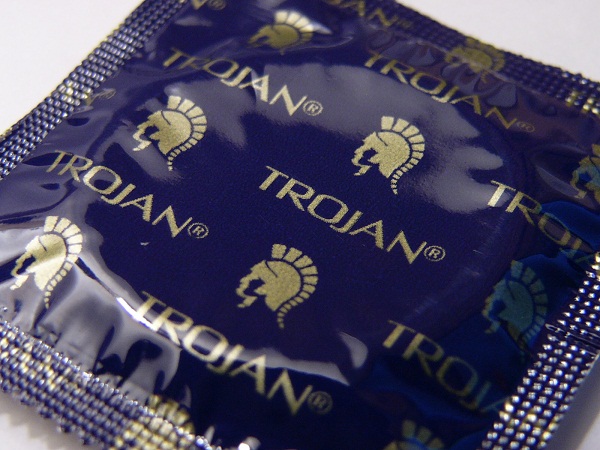
Trojan (at least in North America) is to condoms as Kleenex is to tissues. It’s original manufacturer, Young’s Rubber Company, was the first to develop the latex condom in 1920 and has had a monopoly in drugstores ever since. According to market research firm, SymphonyIRI Group, in 2010, Trojan took 70% of the US condom market bringing in about $270 million annually.
Trojan’s Magnum line offers some of the largest of the crop, both long by wide. Their Magnum XL is 8.1in/206mm length and 2.3in/55.88mm width (Durex XXL is 9.5in/241mm). The rule of thumb: If you measure greater than 5.2in/132mm in girth, than Magnum condoms may be best for you. If your girth is greater than 5.8in/147mm you might consider Magnum XL.
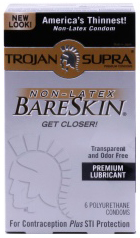
Among their 27 condoms variations we found Trojan Supra with the highest rating by numerous independent sources, such as Slate Mag (2005), Undercover Condoms, CondomUSA, and Condom Jungle. This condom is not made of latex, but of microsheer polyurethane, which bills it as “ultra thin” (not to be confused with Trojan’s Ultra Thin latex version). One major draw back: the Supra is only available with Nonoxynol-9, a spermicidal chemical.
Trojan Extended Pleasure is also popularly rated by the same sources. It contains a special lubricant (benzocaine, a common anesthetic) that is very effective in preventing early ejaculation. Personally, I found this condom to be unreliable and messy. Here is my review from a few years ago. If you do try this condom, be careful not to spill the large glob of lubricant that sits at the tip. It tastes and smells funny.
Not so hot:
On the flip side of Trojan’s dominance, Condom Depot’s annual condom awards reports Trojan condoms scoring low for four consecutive years. Their reviews complain about a lack of sensitivity, dryness, and an overt latex smell.
This site contains affiliate links. When you purchase products through these links, we may earn a commission at no additional cost to you. These commissions help support our work in providing comprehensive sexual health information. We carefully select our affiliate partners and only recommend products we believe will be valuable to our readers. While we may receive compensation for purchases made through these links, this does not influence our reviews or recommendations. All opinions expressed are our own.







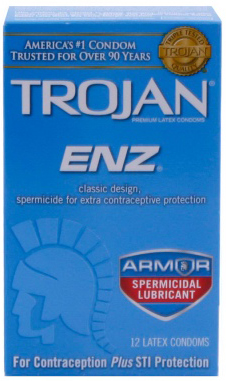
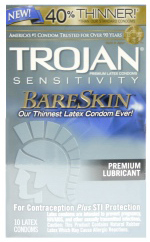

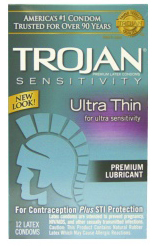 Claimed as Trojan’s thinnest condom
 Claimed as Trojan’s thinnest condom
 Ultra smooth lubricant both inside and out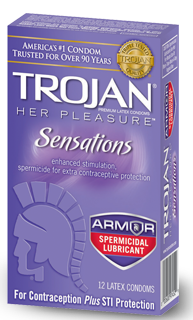
 Dual action lubricant of warm and tingling sensation for both partners
 Contains special lubricant (benzocaine) to help delay ejaculation
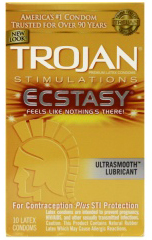 Deeply ribbed along the shaft and head
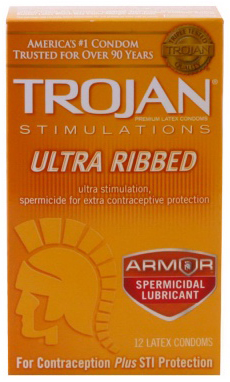 Same features as above, but with Nonoxynol-9 Spermicide
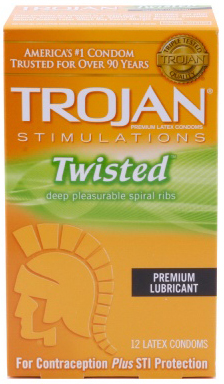 Special twisted shape and ribs for sensual friction
 Assortment includes: Her Pleasure, Twisted, Fire and Ice, and Intense Ribbed.
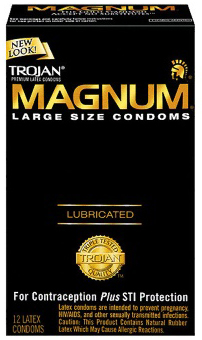 Meant for those that find regular sizes too constricting.
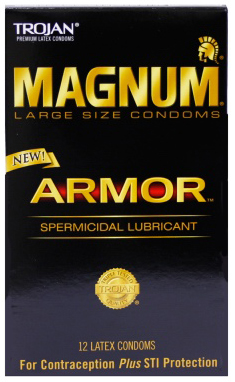 The only condom of the Magnum line that contains Nonoxynol-9 Spermicide
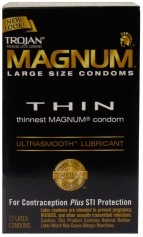 Thinner than the regular Magnum condoms
 Textured along base and head for heightened sensation
 Trojan’s fire and ice lubricant now available in Magnum size
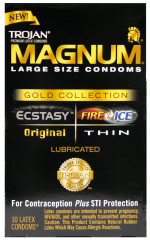 Assortment includes: Magnum Original, Magnum Thin, Magnum Ecstasy, Magnum Fire and Ice
 30% wider than regular size


