LGBTQ 003. In this entry of our LGBTQ-Logue Initiative, posting mementos of sexual justice issues, we share narratives from participants in a study about the gender-based violence that police regularly commit against LGBTQ and gender nonconforming people.
In response to the rise of complaints about hate violence and police abuse against LGBTQ people in Jackson Heights, especially among people of color, the community-based organization Make the Road NY (MRNY) and the Anti-Violence Project (AVP) conducted a preliminary study to ascertain the extent of the problems with police. Between 2011 and 2012, MRNY and AVP collected over 300 surveys with LGBTQ and gender nonconforming people in Jackson Heights. Interviews were conducted by outreach workers and volunteers through street, bar, and nightclub outreach, as well as within support groups and community meetings.
They found that LGBTQ, and transgender respondents in particular, reported higher rates of police stops compared to non-LBGTQ respondents. Transgender residents of color were the most likely to experience police harassment and physical abuse when stopped. 46% of transgender respondents reported some form of physical abuse from police compared to 28% of non-LGBTQ respondents. Narrative evidence obtained through interviews reveals the kind of physical harassment experienced such as handling, pushing, shoving and sexual harassment.
These are not just selective, one-off narrative accounts. On the contrary, they are shared because they reflect general tends respondents experience with the NYPD in Queens.
Carolina describes being intrusively searched by police:
About 2 years ago something terrible happened when I was out in Jackson Heights. My girlfriend and I were on our way to a club when the police stopped us. It was about midnight. The police stopped us and asked for our IDs. My girlfriend had hers but I didn’t have mine with me at the time. At that moment the police started to frisk me and search my pants. Because I dress very masculine they started telling me to ‘shut up you fucking dyke.’ They started to feel my breasts and search in that area (they were male cops and they’re not suppose to do that). They then proceeded to put me against the wall and told me to spread my legs. They searched me between my legs like I was a criminal. I told them that I didn’t consent to their search. But they said that they were ‘the authority’ and that they could do ‘whatever the fuck they wanted’ with me. I felt humiliated because I knew that even if I said something no one would believe me. Also, because of my immigration status I was afraid to say anything and get deported.- Lesbian woman, Jackson Heights (MRNY 2012, pg. 20)
Another interviewee, Juan, reported being drag by her hair down the block.
I was walking down the street with my partner on 34th Avenue and a police car pulled over and told us to get near the car. When the police officer saw that I was dressed as a woman he pulled my wig, held my hair and dragged me down 34th Avenue for 1 or 2 blocks. – Gay Latino man who cross dresses at night, Queens (Ibid: pg. 20).
Other narratives reflect violence committed by police and the unjust treatment carried out while in custody.
I was getting out of a club and heading to a friend’s house in a cab. When I got to her apartment, I found that the police were stopping her and asking her to produce ID. They were talking to her in English. I intervened and told the officers that she didn’t speak English and that her ID was in her apartment, which we were in front of. I told them that I could get her ID from her apartment. The officers told me to shut up and arrested both me and my friend. The police used a lot of force while arresting us and said some homophobic and transphobic remarks in the process. They put us in the back of their car and started laughing at us with other police officers who were also there. I asked one of the officers to please open the window a bit more because we were out of breath, to which he responded by pepper spraying my directly in my face and mouth. Since we were trapped in the back of the car, the pepper spray also started asphyxiating my friend. I started kicking the car door and asking them to please let us out. They opened the door and dragged me out of the car and started beating me up outside the car, while using transphobic and homophobic remarks. It was a very confusing, demeaning and unjust experience, I ended up being in jail for two days without representation and was intensely harassed by officers while I was in custody.- Transgender Latina woman, Queens (Ibid: pg. 18).
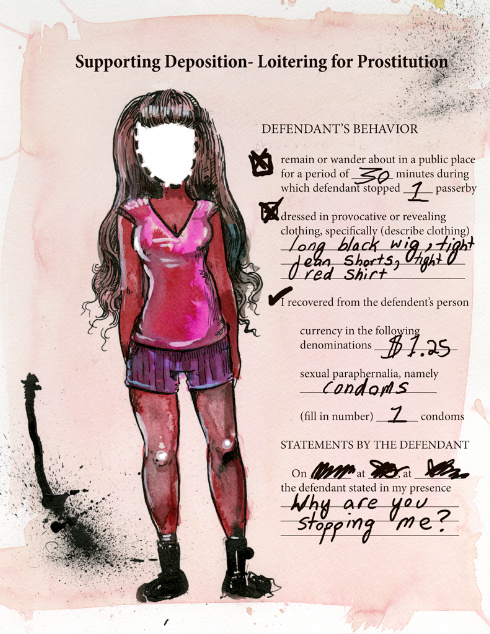
Part of that harassment involves arbitrary stops on suspicion of prostitution, which takes place in the form of a charge of “loitering for the purpose of prostitution”- a misdemeanor that allows for broad officer discretion. The profiling of transgender women as sex workers is so common that there is a term for it: “walking while trans”.
Arrests can be made on the basis of how tight one’s clothing is and how many condoms are on the person, which will be used as evidence in court. If convicted for prostitution, the person will lose social benefits like food stamps and subsidized housing. As a result, transgender women are especially fearful that any condom in their possession will be used as evidence against them.
The survey participants commonly reported stops that seemed to be without basis but in which the police officers later justified the stop by charging the person with prostitution because condoms were found on their person.
Cristina explained how the police did not believe that her boyfriend was not a patron and the officers confiscated three condoms off of her.
One night I was with my boyfriend at a club in Jackson Heights, Queens. At around 4am we left the club together and walked home. We were walking next to each other. At one point an undercover police van stopped next to us. Eight undercover cops got out from the van and some of them threw me against the wall. While they were handcuffing me, my boyfriend was also through to the wall and they frisked him. They told me I was being arrested for sex work. I told them that I was not doing anything like that. After they frisked my boyfriend, they frisked me and found three condoms, after seeing the condoms they asked if I was sure that I was not working. I told them that I was with my boyfriend and they said that he was not my boyfriend. I told one of the female cops to help me and that I was not doing anything wrong. She said that she couldn’t help me out. My boyfriend came to the 110th Precinct where I was held and spoke to the captain; he tried to explain that I was his girlfriend and that I was with him. But the captain said that he couldn’t do anything. I was taken to court and was accused of sex work.– Transgender woman, Jackson Heights (Ibid: pg 21).
Another interviewee describes being jumped by undercover cops and experiencing repetitive humiliation and harassment while in custody:
Last week, I went out dancing at a small night club on Roosevelt Avenue. After having a good time and feeling ready to go home, I contacted my friends so that we could meet at a small taqueria before we all headed home. Meeting up at the taqueria after a night out is routine for us because the tacos are really good, and it’s also the only way we know that our circle of friends is safe.
While on my way to the taqueria, I was approached by a dark colored car driven by a middle-aged male. As the male pulled alongside me, he said something I couldn’t hear properly. As I did not hear what the male was saying, I inched a little closer to his vehicle and he repeated, ‘Why are you so beautiful and yet alone?’ Before I knew it, two undercover officers jumped out of a van that was parked along the street and told me that I was under arrest. When I asked the officer’s why they are arresting me, they told that I was ‘engaging in prostitution’.
They cuffed me and the officers questioned me further, took my purse away from me and placed me into the unmarked van. Although I had nothing on me and did nothing wrong, they still took me, transferred me into another police van filled with about a dozen trans-women and then took us all down to the 115th Precinct where we were fingerprinted, written up and later transferred to the central booking. My experience in the holding cell at central booking was terrible. I was humiliated inside of the holding cell by the guards and the men who occupied the cell with me. The guards would not all me anything other than bread and water to eat and I was not allowed to use the toilet when I needed to go. Tears streamed down my face as for the first time I was encountering the daily harassment that transwomen face for just walking home.-Transgender Latina woman, Queens (Ibid: pg. 17).
And it doesn’t just happen at night after clubbing. It also happens while doing routine daily activities such as walking the dog or grocery shopping. Here is just one testimony of many from the MRNY study.
I am transgender. I was walking to the store near my house on Roosevelt Avenue when two cops stopped and arrested me. When I asked why I was being arrested, they replied, ‘Because you are pretty.’ They charged me with loitering for prostitution when I was only walking down the street.- Transgender Latina woman, Queens (Ibid: pg. 17)
This profiling and abuse has been documented extensively across the US by Amnesty International (2005), the PROS Network (2011) and Human Rights Watch (2012), to name a few. All studies conclude that there needs to be more done within the legal system and law enforcement culture to address homophobic and transphobic attitudes and discriminatory policing against LBGTQ people. Suggestions include LGBTQ liaison units to police forces and integrating LGBTQ issues into officer education and professional development.
There is also a bill to end the use of condoms as evidence of sex work. Since 1999, a coalition of people in the sex trades, allies, and community-based organizations have been working to pass the No Condoms As Evidence bill into law in NY state. In 2012, a report by the PROS Network and Sex Worker Project revealed how the use of condoms as evidence of prostitution is creating a public health crisis because it is deterring targeted populations from carrying condoms. This is “deeply concerning”, writes Emma Caterine of the Red Umbrella Project, as people in the sex trade and gender nonconforming people are often most at risk of contracting sexually transmitted infections. “To combat this violence and promote safer sex, we must stop the use of condoms as evidence by both police and prosecutors (RH Reality Check, 2013).”
On April 23rd, 2013, Red Umbrella Project will be lobbying in Albany, NY to get the No Condoms as Evidence bill passed by representatives. For more information on this bill and how you can get involved, check out their website.
This site contains affiliate links. When you purchase products through these links, we may earn a commission at no additional cost to you. These commissions help support our work in providing comprehensive sexual health information. We carefully select our affiliate partners and only recommend products we believe will be valuable to our readers. While we may receive compensation for purchases made through these links, this does not influence our reviews or recommendations. All opinions expressed are our own.
LGBTQ-Logue 002. “So, are you dating anyone.”
“Nope.” I shamelessly replied.
“Well that’s not good.” my bishop said.
“I don’t want to date anyone.”
Then my bishop looked at me, “Do you experience feelings of same-gender attraction?” What?! All I said is I don’t want to date anyone, how does he…? ‘This is real. Oh gosh, this is very real.’ I paused a good while. I looked at my bishop and in a weak voice replied, “Yeah.” I had never wanted to die more than that moment. Finally realizing the fact. Affirming the fact. Loathing the fact. Breaking through the denial was almost more than I could take. A few words were exchanged and then my bishop looked at me and with genuine empathy said, “That sucks.” – A Gay Mormon Coming Out, Jimmy Hales
Coming out can be a big event- or not. It is a process that’s as individual as you are. And so are the ways of remembering and expressing what coming out is like. Jimmy Hales (blogger and student at the Mormon university BYU) decided to “come out” publicly through video. And a very entertaining video indeed.
Over the course of a year, Jimmy recorded the reactions of his “coming out” to his sister, mother and friends. Many of them don’t believe him at first. Some say they’ve had their suspicions. Overall, it’s an upbeat and chipper mini-doc. And it works to address some fears and misconceptions about coming out and about homosexuality. On his blog, Jimmy explains that he wanted to show others (gay or not) that a Mormon “coming out” isn’t that bad. It can be positive. He also explains how the Church excludes non-heterosexuals by not addressing what is expected of a gay member of the church. Do the rules of celibacy apply to gays? He had to search long and hard and alone for answers.
We thought this was an important memento to share for #2 of the LGBT-Logue Series because there are virtually no representations of -and by- openly gay young Mormons. Do enjoy.
This site contains affiliate links. When you purchase products through these links, we may earn a commission at no additional cost to you. These commissions help support our work in providing comprehensive sexual health information. We carefully select our affiliate partners and only recommend products we believe will be valuable to our readers. While we may receive compensation for purchases made through these links, this does not influence our reviews or recommendations. All opinions expressed are our own.
“The archives of lesbian culture…created four years after Stonewall, owes, at least for my part, it’s creation to that night and the courage that found its voice in the streets. That night, in some very deep way, we finally found our place in history. Not as a dirty joke, not as a doctor’s case study, not as a freak- but as a people.” – Joan Nestle, Co-founder of Lesbian Herstory Archives (Remembering Stonewall, aired 1989 on PBS Radio).
For some, modern history is indexed by the pre-Stonewall and post-Stonewall eras. The 1969 Stonewall Upraising is marked as the first time the LGBTQ community resisted routine police raids and arrests at a time when it was illegal for queers to congregate in public.
All great movements require catalyst- whether it’s premeditated or unplanned- a bandwagon that cements conviction in the will of those affected by injustice; when people discover they are not alone. What starts a movement will be determined by different (sometimes opposing) perspectives, most of which will never be recorded in popular history. Stonewall is one of those seminal events in which thousands who were involved (directly and indirectly) have never had their experiences recognized in official documentation…until 20 years later. StoryCorps founder David Isay with Michael Scherker produced the first documentary of any medium about the Stonewall uprising.
This radio documentary premiered on NPR’s All Things Considered Weekend Edition in 1989. It records multiple testimonies of the event including drag queens who stood up to police, a police marshal who led the raid, and young activists who founded the Gay Liberation Front on the third night of the Stonewall Riots. You can listen and download the broadcast for free at Sound Portaits.org and read the entire transcript here.
The recording begins with participants describing what it was like to be “gay” in the 1960s, before Stonewall.
JOAN NESTLE, Co-founder of Lesbian Herstory Archives: [T]here was regular weekend harassment, which would consist of the police coming in regularly….[I]n the Sea Colony, we had a back room with a red light. And when that red light went on it meant the police would be arriving in around ten minutes. And so we all had to sit down at our tables, and we would be sitting there almost like school children, and the cops would come in. Now depending on…which cop was on, if it was some that really resented the butch women who were with many times very beautiful women, we knew we were in for it because what would happen is they would start harassing one of these women, and saying, ‘Ha, you think you’re a man? Come outside and we’ll show you.’ And the woman would be dragged away. They’d throw her up against a wall and they’d say, ‘So, you think you’re a man, let’s see what you got in your pants.’ And they would put their hand down her pants.
SEYMOUR PINE, Deputy Inspector of the NYC Public Morals Squad: “[Before Stonewall] you tell [patrons in gay bars] to leave and they leave, and you say show me your identification and they all take out their identification and file out and that’s it. And you say, okay, you’re not a man, you’re a woman, or you’re vice versa and you wait over there. I mean, this was a kind of power that you have and you never gave it a second thought.
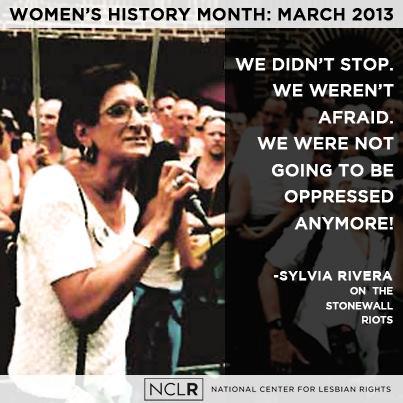
SYLVIA RIVERA, Transgender activist: The drag queens took a lot of oppression and we had to…we were at a point where I guess nothing would have stopped us…we were ladies in waiting, just waiting for the thing to happen.
Those who witnessed and participated in the riot recount the electricity felt in the air as eight police officers arrived at the Stonewall Inn at midnight June 27th, 1969. They describe fire, anger, joy, beatings- by police batons and high heels alike.
BIRDY, Protestor: My name is Robert Rivera and my nickname is Birdy, and I’ve been cross-dressing all of my life. I remember the night of the riots, the police were escorting queens out of the bar and into the paddy wagon and there was this one particularly outrageously beautiful queen, with stacks and stacks of…Elizabeth Taylor style hair, and she was asking them not to push her. And they continued to push her, and she turned around and she mashed the cop with her high heel. She knocked him down and then she proceeded to frisk him for the keys to the handcuffs that were on her. She got them and she undid herself and passed them to another queen that was behind her.
RIVERA: I remember someone throwing a Molotov cocktail. I don’t know who the person was, but I mean I saw that and I just said to myself in Spanish…’oh my God, the revolution is finally here!’ And I just like started screaming ‘Freedom! We’re free at last!’ You know. It felt really good!
Remembering Stonewall also offers rare insight and expression of how the revolutionary event impacted across personal lives and politics. For example, Gene Hardwood, who at the time of this recording was in a 60 year partnership with Bruce Merrow, explained,
GENE HARWOOD: When Stonewall happened, Bruce and I were still in the closet, where we had been for nearly forty years. But we realized that this was a tremendous thing that had happened at Stonewall and it gave us a feeling that we were not going to be remaining closeted for very much longer. And soon thereafter, we did come out of the closet.
JINNY APPUZO: …In 1969 I was in the convent. And when Stonewall hit the press, it hit me with a bolt of lightening. It was as if I had an incredible release of my own outrage at having to sequester so much of my life. I made my way down, I seem to recall in subsequent nights being down on the, you know, kind of just on the periphery looking. An observer — clearly an observer. Clearly longing to have that courage to come out. And as I recall it was only a matter of weeks before I left the convent and started a new life.
PINE: For those of us in Public Morals [police division], after the Stonewall incident things were completely changed from what they had previously been. They suddenly were not submissive anymore. They now suddenly had gained a new type of courage. And it seemed as if they didn’t care anymore about whether their identities were made known.
We were now dealing with human beings.
As shown by Stonewall and earlier campaigns against police raids and entrapment, NYC has a fraught history of with the LGBTQ communities. While great gains have been made, LGBTQ people, and particularly LGBTQ people of color, continue to be targets of police profiling and abuse. This includes profiling transgender women as sex workers, “gender checks”, physical and sexual abuse, and detention of transgender people under dangerous conditions. Check out LGBTQ-logue 003 for narrative accounts of LGBTQ interactions with the NYPD in present-day Jackson Heights, Queens.
This site contains affiliate links. When you purchase products through these links, we may earn a commission at no additional cost to you. These commissions help support our work in providing comprehensive sexual health information. We carefully select our affiliate partners and only recommend products we believe will be valuable to our readers. While we may receive compensation for purchases made through these links, this does not influence our reviews or recommendations. All opinions expressed are our own.
Condom Monologues is thrilled to announce that our Condom Size Chart is up-to-date! This is our most popular post so we think it crucial to keep it spick and span. It includes objective measurements researched by CM’s staff of all the latest condom products from North America’s top three brands: Trojan, Durex and LifeStyles. And we provide links to other works at CM depending on how in-depth you want to know your condom before using.
This is not a company endorsement. We do not cater support for one condom company over another. Instead we offer this as a map to help guide through the frustrating aisle of condoms where each product self-proclaims to be the “Thinnest”, “Most Sensitive”, “Ultra Pleasure” out there. We hope this size chart continues to help find suitable condoms and experience new pleasures.
This site contains affiliate links. When you purchase products through these links, we may earn a commission at no additional cost to you. These commissions help support our work in providing comprehensive sexual health information. We carefully select our affiliate partners and only recommend products we believe will be valuable to our readers. While we may receive compensation for purchases made through these links, this does not influence our reviews or recommendations. All opinions expressed are our own.
If you landed here from search, you were probably looking for a straight answer about LGBT Logues. This guide covers what the product or topic is for, when it makes sense, what to watch for, and where to compare fit before buying.
Quick take
LGBT Logues is best understood as a storytelling and education lens for safer sex that treats identity, consent, pleasure, and protection as connected rather than separate topics. The most important thing is not the marketing name; it is whether the condom fits, stays in place, feels comfortable, and is used correctly from start to finish.
Who this may be best for
readers looking for inclusive safer-sex writing
people who want sexual-health education without shame
anyone exploring condoms, barriers, consent, and communication
Fit and comfort matter more than the label
Condom problems often get blamed on the wrong thing. A condom may seem too thick, too dull, too slippery, or too fragile when the real issue is width. Nominal width is the flattened width of the condom, and it is usually more useful than the broad label on the box. If condoms slip, bunch, squeeze, or break, compare your measured girth with a size chart before switching styles.
Safety basics
Use a new condom every time. Check the expiration date, open the wrapper carefully, pinch the tip, roll it all the way down, and hold the base when withdrawing. For latex condoms, use water-based or silicone-based lube. Do not use oil-based products with latex because they can weaken the material.
What to watch for
Safer sex advice should be inclusive but still specific to the act, anatomy, and STI risks involved.
Condoms are one tool; dental dams, gloves, testing, PrEP, and communication may also matter.
Comfort and consent are part of protection, not extras.
How to compare this option
If you are choosing between Condom Monologues options and other condoms, compare three things: material, texture or thickness, and nominal width. Texture and thinness affect sensation, but width decides whether the condom feels secure and comfortable. If you are unsure, start with the calculator and then compare the closest matching sizes on the chart.
Bottom line: LGBT Logues can be a good match when the use case is right, but the best condom is the one that fits correctly, feels comfortable enough to use consistently, and is paired with the right lubricant and habits.
This site contains affiliate links. When you purchase products through these links, we may earn a commission at no additional cost to you. These commissions help support our work in providing comprehensive sexual health information. We carefully select our affiliate partners and only recommend products we believe will be valuable to our readers. While we may receive compensation for purchases made through these links, this does not influence our reviews or recommendations. All opinions expressed are our own.
The reason so many guys ask, What Condom Size Am I? is because condom sizing and how to measure ourselves is not very clear. There is no such thing as one-size fits every individual or couple.
And yet using the right condom is essential. The wrong size increases the risk of breakage, slippage and discomfort. Experimenting and finding the correct condom is the difference between those who enjoy sex with condoms and those who hate them and use them inconsistently, putting themselves and others at risk of STIs and unwanted pregnancy.
Published with permission from thebadchemicals.com
Quick answer: to answer what condom size am I, measure erect girth first, estimate your starting nominal width, and place yourself into a snug, regular, large, or XL fit range. Use the condom size calculator after you know that starting point, and use the condom size chart when you need brand-by-brand comparisons.
Quick fit picks
Condom size starter picks by girth
If you already have a girth measurement, start with the closest fit path below, then use the calculator and chart to compare nearby widths before buying.
Product links go to Condomania. Use coupon code CONDOMMONOLOGUES where applicable.
What Condom Size Am I?
The first thing you need to do is measure the size of your penis. This isn’t hard (but your penis must be to get correct measurements!). There are three main measurements you need to take. First, from the base of your penis which is the part where the condom would stop rolling (no need to put the condom over your testicles!) and measure up to the tip of your penis….This is your length.
Then measure the girth of your penis at the mid-point of the shaft. You can wrap a tape measure around the shaft or you can use a string and then measure the string with a ruler.
Most condom widths are measured by the condom laying flat (it is not the circumference). Condoms are designed to fit securely while forming the body shape. The base width should be less than half the girth of your penis size by about half an inch (13mm). Therefore to know if your girth will fit a condom width simply divide your penis circumference by 2.25 (In this post we explain how we got this formula).
(Most links are internal links to our site. External links to condoms may be affiliate links that earn us a small commission. This is not a company endorsement).
What Sizes Exist?
Now that you have the measurements, use this page to decide your starting fit range first. Most people land in the regular band, snug fit usually starts below about 4.8 inches of girth, and large or XL fits start once you move past roughly 5.2 inches. After that, go to our Condom Size Calculator to compare exact products and use the updated size charts for Trojan, LifeStyles, Durex, Kimono, ONE Condoms, and Caution Wear when you need brand-by-brand comparisons.
The average condom length in North America…
is 7.5″/190.5mm. Since a vast portion of men are between 5.1″ – 6.5″, most do not need to be concern with length. If length is your concern, check out our condom fitting solutions chart for recommendations to specific needs.
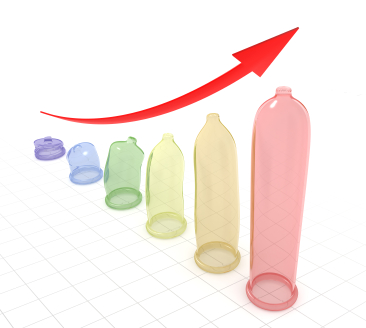
Girth or “thickness” is crucial. The average condom is made to fit a 4.8″- 5.2″ erect circumference. In condom terms, that equals approximately 2.0″/50.8mm-2.2″/55.8mm base wide (remember, width is measured by the condom lying flat).
General, rule of thumb: If you measure less than 4.8 inches girth, go with a snugger fit. Fit you are greater than 5.2 inches, select large condoms, such as SKYN Large, Durex XXL, and Magnums.
Shape Matters
However, this does not solve all problems. What if you are skinny and long, short and wide? You will also need to think about shape and material (latex, polyisoprene, etc.), especially if you find you’re in between sizes.
A common complaint is that condoms are too tight around the head. So, many condoms companies have now designed condoms with oversized head room, including flair shape design and extra bulbous head. Here are the top North American brands:
There are two new non-latex options available now. Polyurethane was first introduced by Durex in the 1990s. This material is less elastic than latex and polyisoprene, and is slightly thinner. So it can be ideal for those who prefer less skin-tight condoms that clings to every contour of his tool, and instead prefer a bit of give in the condom.
The most popular polyurethane condom in North America is Trojan Supra.
Polyisoprene is the latest non-latex material for male condoms, introduced by Lifestyles in 2008. This material is more soft, elastic and form-fitting than both polyurethane and latex. This material is ideal because it can stretch more comfortably over shapely parts of the penis. So this may be a better option if you are in between sizes then the uniquely shaped condoms. Polyisoprene is available in North America by Durex Avanti Bare and Lifestyles SKYN.
Practice Makes Perfect!
The best thing to do is keep experimenting to find the best condoms for you (and your partners).
Just make sure you don’t engage in oral or penetrative sex if a condom does not fit! So, firstly, answer the question “What Condom Size Am I?” for yourself and then check against the size charts and get a hold of your best fit.
Let us know if you have any questions at all and we will always do our best to fully answer them. Don’t be embarrassed. Use a fake name if you really need to. We will never judge you for your questions.
Thanks for reading and we hope this article helped.
If you enjoyed the article “What Condom Size Am I?” Join us on Facebook or Twitter @CondomMonologue for more.
Latest Condom Fit Guides
Use these newer guides with the calculator and chart when you are comparing condom width, girth, material, and fit problems:
This site contains affiliate links. When you purchase products through these links, we may earn a commission at no additional cost to you. These commissions help support our work in providing comprehensive sexual health information. We carefully select our affiliate partners and only recommend products we believe will be valuable to our readers. While we may receive compensation for purchases made through these links, this does not influence our reviews or recommendations. All opinions expressed are our own.
We are celebrating Valentine’s Day 2013 by acknowledging some of the most lavish, smart, and intriguing safer sex resources out there and giving them our thank yous for their hard work.
For safer sex guidelines we applaud and recommend you check out the following…
Planned Parenthood: A non-profit health organization that offers reproductive health care and advice on contraception, safe sex, and family planning. They’ve been around since 1939 and in many cases are the only place where one can access birth control, STD/STI testing, sex education, couples counseling, etc.
The Body: A medically-based HIV/AIDS resource in the US which provides information on everything one needs to know about HIV/AIDS, including advice on prevention, HIV testing, treatment, safely navigating a mixed-status relationship, HIV/AIDS policy and activism, and the latest research on HIV/AIDS and other STDs. This humongous site offers everything from Blogs, podcasts, bulletin boards, “Ask the Experts” forum, first-person stories and interviews, conferences and news coverage, and library resources.
SEX ETC: Who better to understand high school sex politics than the peers who are living and experiencing it themselves. The blog, magazine, and stories on this site are written by and for teens and young adults across North America. It provides different media to engage with sexual health info, such as videos about safe sex, forums where teens can participate and moderate discussions with other teens, a 400 words sex glossary, a state-by-state reference to info on birth control, health care access and your rights to sex education in “Sex in the States” guide, and a range of surveys and guides to sex ed activism.
Scarleteen: A progressive sex-ed site written for teens who are female, male, genderqueer; gay, straight or somewhere in between. It provides over 200 articles about sex, health, and relationships, covering everything from STIs to sexual orientation, body image, self-esteem, to birth control, masturbation, misogyny, sexual abuse, and technical advice from French kissing to BDSM. The site also provides interactive question-answer-discuss services, including their new live help feature providing safe, anonymous live chats with Scarleteen’s staff and volunteers.
SEX-ED LOOP: Another great resource for teens, based in Chicago, that gives up to date information on sexual health, rights, and identity through a range of social media channels including a weekly text messaging service and clinic finder that will identify health care services throughout Chicago. Also provides helpful articles about gender identity and sexual orientation.
HIV InSite:A non-commercial, well-established source developed by the Center for HIV Information at the University of California San Francisco. The site offers an extensive collection of original material including a complete textbook about the clinical management of HIV/AIDS. It is also a great resource for global HIV/AIDS research, statistics, and policy analysis.
Our Bodies Ourselves: A global non-profit that promotes evidence-based information on girls’ and women’s health. The information provided on the site is vast and includes excerpts from their famous book on reproductive health, as well as first-person blog stories that range from topics like body image, nutrition, menstruation, pregnancy and much more.
Well, that’s a handful of some of our favorite safer sex resources from sound sexual health organizations. Do you have any resources to share? Please let us know in the comments below!
This site contains affiliate links. When you purchase products through these links, we may earn a commission at no additional cost to you. These commissions help support our work in providing comprehensive sexual health information. We carefully select our affiliate partners and only recommend products we believe will be valuable to our readers. While we may receive compensation for purchases made through these links, this does not influence our reviews or recommendations. All opinions expressed are our own.
A site about condoms and condom stories is never complete, and neither is the lavish, outlandish history of the device. It’s history is full of insights into human character with all its flaws and foibles.
The invention of the latex condom is relatively new in modern history. However, the principle to protect against sexually transmitted diseases and infections (STIs) dates back to at least 1,000BC (Perera, 2004: 95). Ancient Egyptians were protecting themselves with linen sheaths from a parasitic disease known as Schistosomiasis. Anthropologists have also found evidence of female condoms to prevent pregnancy. The Petri Papyrus of 1850BC lists several female condoms, one of which was crocodile’s dung cut up on auyt-paste and inserted into the vagina. In fact, animal dung was used as a female contraceptive across many societies. The Aztec Badianus manuscript of 1552 explains, “and you shall put into the vulva the crushed herb of the calabash or cucurbita root and eagle’s excrement.” Dung stuffed linen aside, the one devise that could protect against both STDs and pregnancy wasn’t produced until 1855 during the industrial revolution and the advent of vulcanized rubber.
Of course, when safer sex first became a known practice in ancient societies, the scientific frameworks for understanding biology, medicine, sexuality, and public health were vastly different. Hippocrates, the father of western medicine once stated, “After coitus if the woman ought not to conceive, she makes it a custom for the semen to fall outside when she wishes this” (R.I.Chalmers, 1987)… pause … blink … isn’t this reminiscent of the 2012 Teaparty Candidate Todd Akin’s infamous statement that women’s bodies can prevent pregnancy in cases of “legitimate rape”?
Anyway, I’m not stating that the risks of unwanted pregnancies and transmitting or contracting STIs is significantly less in contemporary life because we may have greater public awareness and better medical technology. Rather it’s to recognize that health science and perceptions of “risks” and “healthy” sexuality are products of social contexts- its history and location, politics and economics- and therefore have a transformable quality. That’s what makes the story of the condom throughout human civilization so interesting; because, like a flirtatious cuttlefish, it morphs into so many different types, shapes, and sizes, not to mention the amount of knowledge, myth and stigma that have carried throughout its making.
Contraceptive Censorship
Just to mention a few effects of stigma: In 1873, the U.S. government illegalized the advertisement of any contraception. That same set of laws also allowed for the confiscation of condoms sent through the mail and banned the sale of any condoms in up to thirty states (Collier, 2007). Due to the belief that venereal disease was the price one paid for sinful choices, health experts from The American Social Hygiene Association objected to American soldiers being issued condoms- so during WWI they weren’t (Perera, 2004).
So what preceded the latex condom? As the most basic device for safe sex, different versions of the barrier method were utilized in most societies for millennium, and thus it is near impossible to account for all sexual practices, customs, beliefs, and attitudes. Here we take a glimpse into some western society habits in which the devise was made at the expense of sexual pleasure; almost all made with only hetero-male health and interests in mind; and certainly most practices kept in secrecy from public mind and records.
Medieval to Victorian, Dung to Intestine
The first western medical record of the condom is found in Gabriello Falloppio’s book on syphilis published in 1564 when the STD was a European epidemic. He details condoms that he made from linen sheaths dipped in salt and herbs and tied under the foreskin. Nothing in his records test comfort or sexual satisfaction, but we do know that animal intestines eventually became the superior condom material.
Users tended to hail from higher-income strata as condom were expensive and available only in boutique shops in the cities where seamstresses handmade each baudruches. Louis XVI could afford to have his animal-bowel condoms lined with velvet and silk. There were some available for those with less income if one was willing to buy second-hand. As Shyama Perera’s explains in her book Taking Precautions: An intimate history of birth control (2004), there was a “Miss Jenny” in 1820s London who hand-washed used condoms and resold them at a more affordable price.
The Rise of Rubber
By the 1850s, vulcanized rubber was invented and condoms started to roll out of factories. The process was labor intensive as each rubber condom was dipped in cement and then hand-shaped and smoothed by rubbing and trimming. It was also a major fire hazard because gasoline and benzene were used to suspend the rubber. Rubber condoms were reusable and had a shelf life of about 3 months making them more economical, but the “skin” condoms remained the preferred product for better comfort and sensitivity (keep in mind, lubricant wasn’t invented until 1957. Ouch!). Also, at this time, there were no standard quality control methods. According to condom historian, Aine Collier, some American factories sold their defective condoms at a cheaper price rather than discard them.
Another outcome of the Industrial Revolution was the beginning shifts of condoms away from a sign of wealth towards health. By WWI, the use of condoms was more prominent among European soldiers as the rate of STDs increased. Armed forces would distribute them for free to its members even in countries where condoms were illegal for the general population (the U.S. military did not catch on to condom sense until WWII).
Introducing Trojan Latex
In 1920, Young Rubber Company, the makers of Trojan, was the first to manufacture a latex condom, which was a great improvement from the rubber condom because they were easier and far less of a fire hazard to produce. Latex is also thinner, smoother, and stronger with longer lasting shelf life then rubber. By 1932, Europe’s first latex condom, Durex, was manufactured on conveyor system assembly lines, making them far less labor intensive nor subject to human error.
Marie Stopes’s first health clinic in London did make condoms readily available and was the only outlet from which women could buy them. However, the clinic encouraged women to use female contraceptive techniques, such as the cervical cap, rather than rely on protection made for men.
Quality Control
Stigma around the use of contraceptives continued and disinformation meant that not everyone trusted condoms. Of course, the lack of quality control specifications didn’t help. Perera (2004) documents rumors stating that Catholic factory staff would deliberately poke holes in condoms. The introduction of electronic testing machines helped eradicate rumors. By 1957, the manufacturing process advanced to dramatically reduce the amount of defective rubber and latex, and also allow the first lubricated condom on the market. It wasn’t until the 1960s that most countries in Europe and North America established a certification of national standard specifications for condoms manufacturers to follow.
What were once common problems of slippage and breakage are virtually obsolete with contemporary production. Today, different studies on latex condom breakage tend to reflect a breakage rate of around .4%, or only 4 breaks in every 1,000 uses. Which means that if a condom breaks than it is highly likely caused by user-error rather than manufacturer issues.
The Discovery of AIDS and Height of Condom Use
With industrialization, condoms increasingly became relied upon. Yet it wasn’t until the 1980s and 90s when HIV/AIDS was first declared a pandemic, that condoms became fervently promoted by governments and health organizations. Within the first year of the UK campaign, condom sales increase by 20%. 1988 was the first time in condom history in which condoms were the most popular birth control choice for British married couples. In the U.S., condoms ranked third in popularity among married couples, and a strong second among single women following the Pill.
The Femidom
It was during the time of the first HIV/AIDS crisis that the female condom was manufactured on a large scale despite many experts’ false and damaging advice that women were at “low risk” of contracting HIV. The Femidom, or FC2, is far more advanced than lemon halves used by ancients and cervical caps promoted in the 1920, which do not protect against STDs/STIs. The FC2 is a device made of polyurethane that is inserted into the vagina with a wide base that sits on the outer parts of the vulva. Besides allowing females to be in control of condom use, another advantage of the FC2, is that it can be inserted for up to 8 hours before sex- so no intermission needed for application.
Contemporary Condom Conundrum
The twenty-first century condom is produced by a greater range of manufacturers, non-profit organizations, and government programs around the world. Thanks to modern technological innovation, condoms are far more comfortable, safer, stronger, and smoother then Greek goat’s bladders or oiled silk paper. Who knows what the next advancement will be. There are reports of spray-on condoms in the midst.
The promotion and availability of condoms has also dramatically improved. Nowadays, condoms are typically displayed in public restrooms, supermarkets and pharmacies, or bought in bulk online without age restriction or parental consent required. And they are affordable enough to not need rinsing and re-using!
Condoms have reached a status of “common sense” for many. An American-based 2010 study by the Alan Guttmacher Institute found that the condom is the most common protection used at first intercourse (females 68% and males 80%).
However, the same study found that as individuals continue to have sex, their use of condoms decreases as they get older. The rate of STDs/STIs is extremely high among American youth: One in two sexually active individuals will get a STD usually before the age of 25. According to the American Academy of Pediatrics and the Henry J. Kaiser Family Foundation, two-thirds of all individuals who become infected with STIs in the United States are younger than 25 years old! The reason for this is because young people simply are not using condoms and other barriers consistently or correctly to protect themselves and their partners.
Want to see a visual account of condom history? Here is a mini-documentary (7:47min.) by Trojan to commemorate Condom Month (February, of course), and posted by Queerty Online Mag.
…So the condom campaign continues. History never ends. For a more on problems with condom use, read here about the case to include more condoms in everyday popular culture.
This site contains affiliate links. When you purchase products through these links, we may earn a commission at no additional cost to you. These commissions help support our work in providing comprehensive sexual health information. We carefully select our affiliate partners and only recommend products we believe will be valuable to our readers. While we may receive compensation for purchases made through these links, this does not influence our reviews or recommendations. All opinions expressed are our own.
I’m sure you know, or at least have heard of someone who claims that condoms make sex feel less good. Condoms (and other safe sex tools) don’t have the best reputation. It doesn’t help that we rarely see safer sex happening in media representations of sex that is hot, fun, or romantic. But it doesn’t have to be this way. As we’ve discussed elsewhere, there is no solid empirical evidence to back up negative claims about condoms. Studies find that people who use condoms correctly and are used to using them tend to report greater pleasure with protected sex than those who go without protection.
This does not mean that people on an individual level do not experience problems when enjoying protected sex. There is a difference between knowing how to put on a condom and knowing how to use them well. That is why it tends to be people who use them often and consistently that report greater sexual satisfaction. It takes practice and know-how to feel confident and learn what feels good for you and partner(s). Condoms can add a playful and sexy dimension to sex but, as with anything sexy, you need a positive attitude and a dash of creativity. In this post, we offer some ways to help spice up condom use.
In sum, the main tricks to loving the glove are:
1) Communicate 2) Take turns putting it on 3) Practice 4) Be prepared 5) Be playful and have fun 6) Lubricant! 7) Be aware of condom sizes and experiment with different ones
For more on these points, continue reading. Warning: explicit, NSFW illustrations below.
Before we begin, the basics of condoms should be known. Check out our user manual. Once you understand these essential steps to condom care you can explore ways that may enhance sexual pleasure and make condoms a part of sex- rather than a disruption to it.
This post focuses on condom use for penis and sharing sex toys, but some tips here can also apply to safer anal and vaginal oral sex using barriers including condoms, dental dams, cling film saran wrap, or latex/nitrile gloves. For more info on protective lesbian sex check out this sex column. For specifically gay protective sex info, the Gay Men’s Health Charity is an excellent resource. (Some links are affiliate links that earn us a small commission).
Introducing condoms to partners
This isn’t something that should feel awkward no matter how casual or serious your relationship. It can be as simple as just stopping what you are doing and handing over a condom. Sometimes you won’t need to say anything at all. Or, as suggested by Robin Mandell at Scarleteen, when you feel the heat turning up and sex might happen, take a quick break and retrieve condoms from wherever you keep them (ideally with easy access- discussed below). You can say something as casual as, “No pressure. I just wanted to get these out just in case we need them.”
Condoms do not keep people from getting close- Silence does.
Asking someone to use a condom is to show care for the well-being of you both. Communication really is key and talking about sex might mean explaining what you like, what’s your favorite position, or how to use condoms and use them in ways that work for you both. Talking together about these things will cultivate intimacy and deepen your bond (not hinder it!), because you are sharing the responsibilities of sex and caring for each other.
Great sex is about sharing control
As Heather Corinna explains, this is something that safer sex can help support. Learning how to discuss condom usage and exploring sexy ways to put on a condom and what feels good together will make talking about other facets of sex a lot easier, such as how you’d like to try something new. This also means that both people are making decisions and choices which are fundamental to both amazing sex and healthy sexuality.
Take turns putting on barriers
Related to the above- condoms can be a lot more erotic when one partner puts it on the other. There are many ways to turn up to heat with a condom. When done in a deliberately slow manner with some stroking, teasing, eye contact, putting on a condom can be exciting.
You can put the condom on together. For example, one person takes the condom out of its package and places it over the head of the penis (make sure that you unravel it right-way down, not inside out). The other person pitches and holds onto the reservoir tip of the condom as the other unrolls it down the shaft of the penis with one (or two hands). This not only turns up the heat, but also ensures confidence in both actors that the condoms is put on correctly.
Practice Makes Perfect
Learn how to put it on. You can use the ol’ fashion banana, or the aid of a dildo or willing partner to practice how to unravel the condom. It should unroll downward to the base without too much pulling or stretching. If any exertion is needed to get the condom to the base then it is probably the wrong size. Practicing by yourself will relieve any worry about losing an erection or the uncomfortable pressure of being judged on your condom skills. Ladies and guys, you can always practice when you masturbate. This will also help you learn your pleasure spots and what feels best with protection. Or practice with your partner. When the time is right, either you or the other can put on the condom, so it’s good for everyone to knows how. For many couples, this also helps to naturalize the process. It’s not about “making” a guy do something; it’s about something people do together for each other.
Be Prepared
One of the great advantages to condoms is that they are readily available for anyone to buy without a prescription and they are relatively cheap- even free at some health clinics like Planned Parenthood. So equipping yourself with this contraceptive takes far less time, research, and planning.
Also, it will help things run a whole lot smoother and greatly reduce the buzz-kill if you can reduce condom-hunting time. So keep condoms (and lubricant) in a dedicated, handy place next to your bed where you are sure to find it.
Be playful
Keeping condoms in an easily accessible place is helpful, but that does not mean that it is always best to rush through the process of putting one on. Great sex is to have fun with it. When you introduce condoms have a sense of play. And if things get awkward as you’re learning how to do safe sex, let yourself laugh about it. This helps take the pressure off.
Buy some glow-in-the-dark condoms and leave your partner in suspense until the lights go out! Or incorporate condoms into erotic foreplay. Try slipping it on his penis with your mouth. If you are using gloves, get some props and play Doctor. Spice it up by carrying a condom with you in your handbag or pocket and discreetly show it to your partner to hint what’s on your mind.
Lubricant
This is really important. Especially, if you or your partners complain about reduced sensitivity, lubricant will improve sensation immensely. Put two drops of water-based lubricant inside the tip of the latex condom before putting it on. Even if dryness is not a problem for a person, lubricant that is made for condoms will lasts longer than the natural stuff.
Two points here. First, make sure your condom fits well. Condoms aren’t one-size-fits-all, and a condom that’s too small or too big is likely be difficult to put on, very uncomfortable, and much more likely to break. If you are not sure what will fit, check out our Condom Size Calculator. If you experience certain discomforts, such as condoms being too tight, or too long, we have suggestions at our condom guide. If you’re providing the condoms, it might be useful to have a variety of types and styles so you and your partner can choose what seems right. Variety sample packs can be found online, and at some drugstores.
Second point, if you are in a longer-term relationship, you have the advantage to experiment with different types of condoms and lubricants together to discover what suits you both best and have fun while doing it! There are many different styles of condoms out there from thin, to thick, to wider in certain spots, snugger in other spots, etc. There’s variety in texture: ribbed, studded, contoured, pouched; variety in non-latex condoms; and there is plenty of variety in lubricants that can enhance sensation dramatically. You could buy a variety pack of condoms to find the best ones. Or make a date out of it and visit a sex shop and choose together.
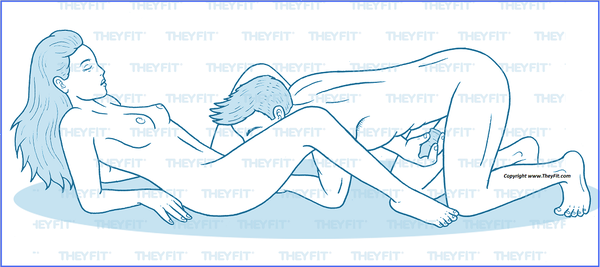
There are hundreds of sexy ways to put on a condom that do not interrupt the flow. Here are just two examples: Excellent hand-drawn illustrations that will no doubt spark ideas by custom condom size company TheyFit.com.
Condoms inclusion technique demo from TheyFit.comCondom inclusion technique demo from TheyFit.com
———————-
If I haven’t convinced you yet about the sensual side of condoms, take this with you: Everyone needs to accept this reality. If you’re sexually active and not practicing safe sex then you are likely to transmit or contract a disease or infection. To prevent this from happening, to experience healthy fulfilling sexuality, you have to learn how to use protection.
This site contains affiliate links. When you purchase products through these links, we may earn a commission at no additional cost to you. These commissions help support our work in providing comprehensive sexual health information. We carefully select our affiliate partners and only recommend products we believe will be valuable to our readers. While we may receive compensation for purchases made through these links, this does not influence our reviews or recommendations. All opinions expressed are our own.
Condom Size Chart: Compare 158 Condoms by Width, Length, Shape & Material
Finding the right condom size matters more than most people think. A condom that fits well is more comfortable, more reliable, and more likely to actually get used. A condom that’s too tight can break or feel uncomfortable. Too loose, and it can slip off. Either way, the experience suffers — and so does safety.
This condom size chart covers 158 individual condoms available from Condomania, one of the most trusted independent condom retailers. Every product listed includes verified dimensions, material, shape, and a direct purchase link.
Bonus: if you’re ordering from Condomania, use coupon code CONDOMMONOLOGUES for 10% off where applicable.
The Complete Condom Size Chart
Start with your fit problem.If you are not sure, use the Condom Size Calculator, then compare the closest products below. Use coupon code CONDOMMONOLOGUES at Condomania where applicable.
Brand: Unique Condoms Width: 50 mm / 1.97 in Length: 6.29 in / 160 mm Thickness: 0.015 mm Notes: Lubricated, Ultra Thin, Vegan Buy at Condomania
How Condom Sizes Work
Most people think condom size is about length. It usually isn’t. In real life, the most important measurement for fit is nominal width — the flat width of the condom when laid flat, usually measured in millimeters.
Why does width matter so much? Because width determines how tight or loose the condom feels around your shaft. A condom that is only a few millimeters too small can feel uncomfortably tight. A condom that is a few millimeters too large can bunch up, slip, or feel insecure.
Length still matters, especially if you find condoms too short or if you have a lot of excess roll at the base. But for most people, girth fit matters more than length fit.
What is nominal width?
Nominal width is the standard sizing measure used to compare condoms. If you laid a condom flat and measured it straight across, that measurement would be its nominal width. That’s the number you see in millimeters, like 49 mm, 53 mm, 56 mm, or 60 mm.
As a rough guide:
Small / Snug = under 50 mm
Medium / Standard = 50–54 mm
Large = 55–57 mm
XL = 58 mm and up
Those categories are useful for browsing, but always remember that the exact millimeter width is more important than the marketing word on the box.
How to Measure for a Better Condom Fit
If you want a condom that actually feels right, measure first. You only really need two numbers:
Girth (circumference) — Wrap a soft tape measure or strip of paper around the thickest part of your erect penis.
Length — Measure from the base to the tip along the top side.
For condom fit, girth is the priority. If you know your circumference, you can estimate your ideal condom width much more accurately than by just guessing what sounds “normal” or “large.”
Quick rule of thumb
A lot of people use a simple fit shortcut: divide your erect girth by about 2.25. That gives you a rough target range for condom width.
Want the chart translated into a pick? Use the condom sizing guide for the full girth-to-width walkthrough. If latex-free material is part of the decision, compare non-latex condoms by size and fit before choosing a brand.
Why the Right Fit Matters
Too tight — can feel restrictive, reduce sensation, and increase breakage risk.
Too loose — can slip, bunch, or feel less secure.
Good fit — feels comfortable, stays in place, and improves confidence.
If condoms have always felt annoying, there is a decent chance you simply haven’t been wearing the right size or shape.
Shape Matters Too
Fit isn’t only about width. Shape changes how a condom feels during sex.
Straight — same basic width from base to tip.
Flared — more room at the head, often more comfortable for people who feel constricted at the tip.
Contoured / Comfort Fit — shaped for a more anatomical fit.
Snug Fit — narrower overall for a tighter feel.
Pleasure Shaped — often textured or specially shaped for extra stimulation.
That’s why two condoms with the same nominal width can still feel different. One might feel perfect, and another might feel weird, even if the width number matches.
Condom Materials Explained
The chart includes multiple materials because not everyone wants or can use standard latex condoms.
Latex — the most common, stretchy, effective, and widely available.
Polyisoprene — latex-free, softer feel, popular in products like SKYN.
Polyurethane — thinner feel, less stretchy than latex.
Nitrile — newer non-latex option with good heat transfer.
Lambskin / natural membrane — very different feel, but not appropriate for STI protection.
Those pages go deeper on the specific shapes, materials, and quirks of each brand. They’re useful if you want to compare within one brand before trying something new.
No. “Standard” is not a strict technical size. Many standard condoms fall in the 52–54 mm range, but shape and length still vary.
Are Magnum condoms really huge?
Not always. Many condoms marketed as “large” are only slightly wider than standard condoms. That’s why exact width matters more than branding.
What if I need a smaller condom?
Look at products under 50 mm nominal width. You can also use the calculator and our fit guides to identify snugger options.
What if I need a non-latex large condom?
Use the chart filters to combine Large or XL with Non-Latex. That’s one of the quickest ways to find realistic options.
About This Chart
This chart is designed to make condom shopping less confusing and more useful. We combine brand information, retailer data, and independent fit-focused organization into a single searchable table.
All purchase links on this page go to Condomania. If you order there, remember to try coupon code CONDOMMONOLOGUES for 10% off where applicable.
This site contains affiliate links. When you purchase products through these links, we may earn a commission at no additional cost to you. These commissions help support our work in providing comprehensive sexual health information. We carefully select our affiliate partners and only recommend products we believe will be valuable to our readers. While we may receive compensation for purchases made through these links, this does not influence our reviews or recommendations. All opinions expressed are our own.