A study published in June 2012 argues that penis shape and size must be taken more seriously by public health officials and activists who aim to increase consistent and correct condom use. Researchers Michael Reece and Debra Herbenick of Indiana University found a substantial percentage of men reported condoms being too tight, too loose, too short, too long, breakage, leakage…basically, general condom discomfort that can result in misuse or disuse, which translates into a serious public health issue.
The majority of condom products are fitted for “average” length at 6.4 inches when erect (see the Kinsey report and The Simple Truth about Erect Penis Size). However, as Reece and Herbenick found, length of the condom is not the greatest discomfort; rather, it is fitting around the head and shaft that scored highest among complaints, with penis base at a close second. For example, of those men who reported that condoms were too tight, 66% reported tightness around the base, 70.4% around the glans, and 73% around the shaft.
The study concludes that HIV and STI practitioners must get involved with condom manufacturers to ensure that condoms are consistent with men’s experiences of fitting and pleasure. Indeed, no matter what size, all men should have access to well-fitting condoms.
Quick Tip! The FC2 internal condom is one size fits all. Because it’s made to form to the inner walls of the receptive partner, penis size is irrelevant. This is a great solution for those fitting woes.
Sizing
To know which condom width fits, we recommend dividing penis circumference by 2.25.Here we explain where we got this formula.
Image from @TheyFitCondoms
Given the wide range of condoms on the market, prevention providers can play a valuable role in helping men to identify condoms that suit their size specificities, hence increasing the likelihood of consistent condom usage. For a large proportion of those who reported tightness around the glands (70%), for example, HIV and STI prevention providers may alleviate men’s perceptions that condoms all are too tight by recommending condoms that are designed with a more bulbous head to reduce constriction. As our chart shows below, Durex condoms and One Condoms tend to offer a greater variety in contoured shapes and head room.
Here we have organized a list of condoms according to the 4 “problem points” identified in Reece and Herbenick’s study. Under each complaint we provide a list of condoms by brand that may help alleviate discomfort.
Please note: External links may be affiliates that give us a small commission. This is not a company endorsement. Due to the fact that major North American brands are Durex, Trojan, Lifestyles, Beyond 7 and Caution Wear, our first aim is to gather these dimensions. We continue to update.
Slightly longer than regular condoms. Shaped with a secure fit in the middle and spacious head room.
Base width: 2.25″/ 56mm
Mid width: 2.28″/ 58mm
Head width: 2.4″/ 61mm
Length: 7.9″ / 200mm
Same length of regular condoms, but wider and large head with unique ribbed design.
Base width: 2.25″ / 56mm
Head width: 2.4″/ 62mm
Length: 7.4″/ 188mm
Ultra thin, vegan latex, larger condom.
A wider condom with regular length. Great option for shorter but larger headed guys (this is on the smaller end of Large-head condoms). Tapered flare shape that extends to a wide head.
Base width: 2.13″/ 54mm
Head width: 2.36″ / 60mm
Length: 7.5″ / 190mm
This is Caution Wear’s largest condom. Unlike other large condoms, this one is wider than regular condoms, but maintains the same 7.0″ regular length. Good for wider girth without the extra length. Straight shape.
Base width: 2.25″/56mm
Length: 7.0″/180mm
One of the longest and widest most famous condoms on the market. Made with an extra bulbous head and wider shaft width.
Base width: 2.3″/58mm
Head width: 2.7″/68.58mm!
Length: 8.3″/ 210mm
Tapered at the base for a secure fit and extends wider up the head for comfort. Suitable for guys who find standard condoms too short and too tight.
Base width: 2.13″/ 54mm
Head width: 2.5″/63.5mm
Length: 8.12″/206mm
Tapered at the base with spacious head for more comfort. Great choice if you need a larger condom but desire ultra thin latex.
Base width: 2.13″/ 54mm
Length: 8.12″/ 206mm
Uniquely large bulbous head and shaft for more freedom of movement. Ribbed on shaft.
Longer than regular condoms
Base width: 2.13″ / 54mm
Head width: 2.5″ / 64mm
Length: 8.1″ / 205mm
Tapered securely at the base with huge head space. Longer than most condoms. Tingling ginger lubricant (inside and out). Ribbed along shaft and head.
Base width: 2.0″/ 52mm
Head width: 2.5″/ 64mm
Length: 8.1″/ 205mm
Ribbed and studded for extra stimulation
Slightly wider contoured shape at base than regulars; fitted head without the extra length. More headroom.
Base width: 2.15”/ 54mm
Length: 7.9/200mm
First ever large-size polyisoprene condom.
Strong as latex but softer, more flexible material.
Ideal for people with latex allergy or sensitivity.
Wider base and shaft than the Magnum, but not quite as long. Slightly longer than average LifeStyle condoms. Straight classic shape. Ideal for thicker than average guys.
Base width: 2.2”/ 56mm
Length: 7.9”/ 200mm
A large condom without over-sized headroom. Wider and longer than regular Lifestyles.
Contoured pleasure shape to secure fit around shaft.
Base width: 2.2”/56mm
Length: 8.26” /210mm
Exclusive over-sized head room, but with the average length.
Stimulates most sensitive areas for both partners
Base width: 2.05”/ 52mm
Head width: a huge 2.9″ / 74mm!
Length: 7.5”/190mm
Classic straight shape (no flare or bulbous head). Wider and longer than regular condoms.
Made of vegan latex.
Base width: 2.2″/ 56mm
Length: 8.0″/ 205mm
25% thinner than Trojan’s standard condom
Close comfort fit around the shaft. Has the same long length as Magnums with snug fit around the shaft and slightly less head room. Good if one is looking for longer length, but not wider width.
Base width: 2.13″/ 53mm
Length: 8.0″/ 203mm
Is wider and longer than regular condoms. Classic straight shape.
Made of Polyurethane, which is more soft and elastic than latex.
Base width: 2.2”/ 56mm
Length: 7.9”/200mm
Very long. Tapered at the base for secure fit, wide bulbous head.
Special tingling and warming lubricant on inside and outside.
Base width: 2.13″/ 54mm
Length: 8.13″/ 205mm
Dry condom. (Great for oral sex).
Classic straight shape. Longer than regular sizes with standard Trojan width.
Base width: 2.1″/53mm
Length: 8.0″/ 200mm
Trojan ENZ Spermicide Lubricant
The classic ENZ long condom also comes with spermicide lubricant (not for oral use).
Base width 2.1″/53mm
Length: 8.0″/ 200mm
Tapered at the base for a secure fit and extends wider up the head for comfort. Suitable for guys who find standard condoms too short and too tight.
Base width: 2.1″/53.34mm
Head width: 2.5″/63.5mm
Length: 8.12″/206mm
The largest condom made by Durex
Classic straight shape
Compared to Trojan Magnum XL, Durex XL is wider at the base and longer, but smaller head than Magnums.
Base width: 2.3”/58mm
Length: 8.3”/210.8mm
20% thinner than standard latex condoms
Unique easy-on design shape to roll on smooth.
Contoured at the head with a flare shape to the opening.
On the larger side of the regular condom sizes in both width and length.
Base width: 2.1”/54mm
Length: 7.9”/ 200mm
Durex’s thinnest latex condom
Longer than the average condom, with slightly snugger width at the base. Suitable for guys who are looking for more width without the extra length.
Base width: 2.0”/5.1mm
Length: 7.9”/200mm
First ever large-size polyisoprene condom.
Strong as latex but softer, more flexible material- the latest in condom technology.
Ideal for people with latex allergy or sensitivity
Wider base and shaft than the Magnum, but not quite as long. Slightly longer than average LifeStyle condoms. Ideal for broader, thicker than average guys.
Base width: 2.2”/55mm
Length: 7.8”/200mm
Popular contoured shape that flares wide at the head, tapered at the base for secure fit. Suitable for men between approximately 4.54″ and 4.72″ erect girth (slightly greater length is normal for thin condoms to prevent risk of breakage).
Base width: 2.1” / 53mm
Length: 7.8”/ 200mm
Wider and longer than regular Lifestyles condoms. Not quite as long as Trojan Magnums. Suitable to those fit in between regular and XL length.
Flare shape for wider end.
Base width: 2.2”/56mm
Length: 8.3”/210mm
Contoured shape for tapered fit around the base and shaft. Is one of the shortest condoms on the North American market.
Base width: 1.92”/49mm
Length: 6.7”/170mm
Extra ribbed, ultra studded, uniquely shaped.
Uniquely contoured at head for his pleasure (see image here)
Regular condom length but closer fitting shaft and head.
Base width: 1.93”/49mm
Length: 6.69”/ 170mm
Beyond Seven
All Beyond Seven Condoms, except Crown, are less than 7.5 inches long. They also offer some of the thinnest latex condoms on the market.
Beyond7 Ultra Thin Classic straight shape condom. Slightly shorter than standard regular condoms
Base width: 2.0”/51mm
Length: 7.2”/180mm
The thinnest condom makers offer studded condoms for those who love extra stimulation.
Studded along the shaft
Base width: 2.0”/51mm
Length: 7.2”/180mm
Special twisted shape and ribs for sensual friction
Regular length of Trojan condoms, but is 0.25” slimmer at the base than regular Trojan condoms for a snug grip round the shaft.
Base width: 1.75″/44mm
Length: 7.8″/198mm
Durex’s thinnest latex condom
Slightly snugger width and longer length than most regular sizes. Suitable for long and slender guys.
Base width: 2.0”/5.1mm
Length: 7.9”/200mm
Contoured shape for tapered fit around the base and shaft. Is one of the snuggest (and shortest) condoms on the North American market.
Base width: 1.92”/49mm
Length: 6.7”/170mm
This is The smallest condom on the North American market.
Unique shape hugs better around shaft and head
Base width: 1.77”/ 45mm
Head width: 1.92″/ 49mm
Length: 7.0”/ 180mm
Extra ribbed, ultra studded, uniquely shaped.
Uniquely contoured at head for his pleasure (see image here)
Regular condom length but closer fitting shaft and head.
Base width: 1.93”/49mm
Length: 6.69”/ 170mm
4X more lubricant than standard latex condoms.
Thinner than standard condoms with average length.
Base width: 1.9″/50mm
Length: 7.2″/185mm
All other Beyond7 condoms are approximately 2.0 inches base wide. Check out their condom size chart for more detailed measurements on all their products.
————————————
Our size charts are constantly updated, so please join our Facebook, Twitter or RSS feed to keep informed.
This site contains affiliate links. When you purchase products through these links, we may earn a commission at no additional cost to you. These commissions help support our work in providing comprehensive sexual health information. We carefully select our affiliate partners and only recommend products we believe will be valuable to our readers. While we may receive compensation for purchases made through these links, this does not influence our reviews or recommendations. All opinions expressed are our own.
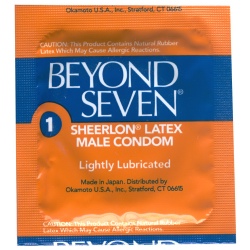
Beyond Seven Condoms. Image from UndercoverCondoms.com
Beyond Seven is the fourth largest condom brand in the world and has been around since 1937 starting in Tokyo, Japan. Standard latex condoms are typically .007 inches thick- but the “Sheerlon” latex of Beyond Seven can measure as thin as .004 thickness, offering one of the thinnest condoms (if not the thinnest!) on the market. These condoms tend to have a standard width of 2.0 inches (measuring the condom laying flat) and to be on the slightly shorter side of standard regular condoms (see our guide on standardized condom sizes). These condoms are perfect if you prefer a snug and thin fit. The best thing to do is experiment with different styles to find the right condom for you. Afflitate links within.
For a comparative search of condom sizes, try our condom size calculator. If you want to compare Beyond Seven against other brands by width, length, and material, use the full condom size chart. Quick Tip! To find the condom width that fits, divide penis circumference by 2.25. Here is how we got this formula.
Zero Zero Four measures the success this condom trumps as being the thinnest condom on the market! Where standard latext condoms are .007, Beyond7 is .004 thickness.
Base width: 2.0”/51mm
Length: 7.2”/180mm
The thinnest condom makers also offer studded condoms for those who love extra stimulation.
Studded along the shaft
Base width: 2.0”/51mm
Length: 7.2”/180mm
Perfect those who want to try all that’s offered from Beyond Seven. This sampler contains 24 condoms including Ultra Thins, Crown, Crown .004, Aloe Enriched, Studded, and Assorted Colors.
————————–
If you are experiencing specific condom fitting problems, check out our fitting solutions guide. Or you can leave a comment below and we’ll help you out.
Our size charts constantly updated, so please join our Facebook, Twitter or RSS feed to keep informed.
This site contains affiliate links. When you purchase products through these links, we may earn a commission at no additional cost to you. These commissions help support our work in providing comprehensive sexual health information. We carefully select our affiliate partners and only recommend products we believe will be valuable to our readers. While we may receive compensation for purchases made through these links, this does not influence our reviews or recommendations. All opinions expressed are our own.
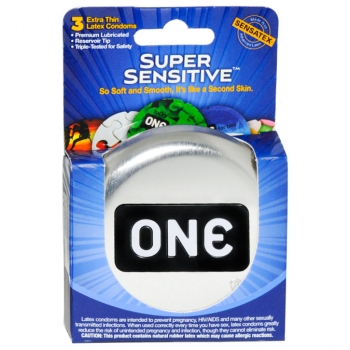
ONE Condoms have a few perks that make them stick out from the rest. First, when it comes to looks, they think outside the square with round packaging and trendy designs that consumers both illustrate and vote for on ONEcondoms.com. Thumbs up for effort to get people interactive with safer sex. Second, is charity. Winning designs become part of their world-wide packaging and a donation of 5000 condoms are made to a non-profit organization of the winner’s choice.
Fun is a big part of this condom- they feature hundreds of colors and shapes and textures. In general, however, they only offer two sizes:
Regular (Base width: 2.1”/53mm. Length: 7.5”/190mm)
and Large (Base width: 2.2”/56mm. Length: 7.8”/200mm).
For a comparative search of condoms without the long lists, try the condom size calculator; if you want the brand-by-brand width table, compare ONE against the full condom size chart.
But keep in mind that size is not everything. Shape is important too. ONE Condoms feature some unique shapes to solve fitting ills. For example, if you are experiencing tight constriction around the head, but the length and shaft are fine, try the dome shape or pleasure pouch or flare shape. See more details below. And check out our Fitting Solutions Guidefor more options. The best thing to do is experiment and try new styles.
ONE does not make non-latex condoms. Lifestyles SKYN Elite Large is the only XL non-latex condom sold at US stores. There currently are no non-latex snug fits on the market, so it is a matter of trying different shapes and designs. Both Durex and Lifestyles have a better variety of non-latex condoms.
This is not a company endorsement! We are independent but some links are affiliate links that earn us a small commission.
Quick picks
ONE condoms to compare first
If you are buying from this ONE size chart, start with the fit or feel problem you are solving. Product links go to Condomania. Use coupon code CONDOMMONOLOGUES where applicable.
This ONE stands out from the rest as the most normal, straight walled condom compared to ONE’s trendy reputation.
Base width: 2.0”/52.89mm
Length: 7.5”/190mm
Offers same length as regular condoms but extra smooth.
Advertised as 50% more lubricant (perhaps this is an upgrade from 2008 when a member of CM reviewed it).
Base width: 2.1”/53mm
Length: 7.5”/190mm
Decorated with oriental-design ribbing, this is one for the most intricate looking jonnies.
Flared shape gives more head-room and a secure fit at the shaft.
Base width: 2.1”/53mm
Length: 7.5”/190mm
Uniquely shaped- some diagrams make it look a bit like a boat rudder; the roomy pouch at the head features fine ribs to stimulate both partners.
Base width: 2.1”/53mm
Length: 7.5”/190mm
Extra-bulbous head room.
Because of it’s unique shape, it is slightly misleading to categorize this condom as “regular” size. Suitable for men who experience constriction around the head and find regular condoms to narrow.
Base width: 2.1”/53mm
Length: 7.5”/190mm
Make sexy fun! FDA approved non toxic glow-in-the-dark condoms. Expose to light for 30 seconds and glows for up to 30 minutes.
Fun fact: ONE Condoms owner, Global Protection Corp., is the first to make glow in the dark condoms.
Base width: 2.1”/53mm
Length: 7.5”/190mm
Get a mixed bag of 9 different choices from ONE’s pleasure line, including Super Sensitive, 576 Sensation, ZERO, Pleasure Plus, Pleasure Dome, Flavor Waves, Glowing Pleasure, Color Sensations, and The Legend.
All regular size, except The Legend.
Wider at head and base, and longer than regular condoms.
Base width: 2.2”/56mm
Length: 7.8”/200mm
Note: Same size as Lifestyle’s non-latex SKYN Large. If you need larger, check out Durex and Trojan.
25% thinner than standard condoms
Flare shape at the top
Base width: 2.2”/56mm
Length: 7.5”/190mm
———————–
This is the latest edition of our condom size chart with the latest ONE condom products. During our research we noticed that some condom retail sites give conflicting measurements for the same condom. So, we gathered our information from the companies themselves and verified sizes with retailers including Undercover Condomsand Condom Jungle. If you come across a falsely measured product, let us know!
Our size charts constantly updated, so please join our Facebook, Twitter or RSS feed to keep informed.
This site contains affiliate links. When you purchase products through these links, we may earn a commission at no additional cost to you. These commissions help support our work in providing comprehensive sexual health information. We carefully select our affiliate partners and only recommend products we believe will be valuable to our readers. While we may receive compensation for purchases made through these links, this does not influence our reviews or recommendations. All opinions expressed are our own.
Condom Monologues is thrilled to announce that our Condom Size Chart is up-to-date! This is our most popular post so we think it crucial to keep it spick and span. It includes objective measurements researched by CM’s staff of all the latest condom products from North America’s top three brands: Trojan, Durex and LifeStyles. And we provide links to other works at CM depending on how in-depth you want to know your condom before using.
This is not a company endorsement. We do not cater support for one condom company over another. Instead we offer this as a map to help guide through the frustrating aisle of condoms where each product self-proclaims to be the “Thinnest”, “Most Sensitive”, “Ultra Pleasure” out there. We hope this size chart continues to help find suitable condoms and experience new pleasures.
This site contains affiliate links. When you purchase products through these links, we may earn a commission at no additional cost to you. These commissions help support our work in providing comprehensive sexual health information. We carefully select our affiliate partners and only recommend products we believe will be valuable to our readers. While we may receive compensation for purchases made through these links, this does not influence our reviews or recommendations. All opinions expressed are our own.
The reason so many guys ask, What Condom Size Am I? is because condom sizing and how to measure ourselves is not very clear. There is no such thing as one-size fits every individual or couple.
And yet using the right condom is essential. The wrong size increases the risk of breakage, slippage and discomfort. Experimenting and finding the correct condom is the difference between those who enjoy sex with condoms and those who hate them and use them inconsistently, putting themselves and others at risk of STIs and unwanted pregnancy.
Published with permission from thebadchemicals.com
Quick answer: to answer what condom size am I, measure erect girth first, estimate your starting nominal width, and place yourself into a snug, regular, large, or XL fit range. Use the condom size calculator after you know that starting point, and use the condom size chart when you need brand-by-brand comparisons.
Quick fit picks
Condom size starter picks by girth
If you already have a girth measurement, start with the closest fit path below, then use the calculator and chart to compare nearby widths before buying.
Product links go to Condomania. Use coupon code CONDOMMONOLOGUES where applicable.
What Condom Size Am I?
The first thing you need to do is measure the size of your penis. This isn’t hard (but your penis must be to get correct measurements!). There are three main measurements you need to take. First, from the base of your penis which is the part where the condom would stop rolling (no need to put the condom over your testicles!) and measure up to the tip of your penis….This is your length.
Then measure the girth of your penis at the mid-point of the shaft. You can wrap a tape measure around the shaft or you can use a string and then measure the string with a ruler.
Most condom widths are measured by the condom laying flat (it is not the circumference). Condoms are designed to fit securely while forming the body shape. The base width should be less than half the girth of your penis size by about half an inch (13mm). Therefore to know if your girth will fit a condom width simply divide your penis circumference by 2.25 (In this post we explain how we got this formula).
(Most links are internal links to our site. External links to condoms may be affiliate links that earn us a small commission. This is not a company endorsement).
What Sizes Exist?
Now that you have the measurements, use this page to decide your starting fit range first. Most people land in the regular band, snug fit usually starts below about 4.8 inches of girth, and large or XL fits start once you move past roughly 5.2 inches. After that, go to our Condom Size Calculator to compare exact products and use the updated size charts for Trojan, LifeStyles, Durex, Kimono, ONE Condoms, and Caution Wear when you need brand-by-brand comparisons.
The average condom length in North America…
is 7.5″/190.5mm. Since a vast portion of men are between 5.1″ – 6.5″, most do not need to be concern with length. If length is your concern, check out our condom fitting solutions chart for recommendations to specific needs.
Girth or “thickness” is crucial. The average condom is made to fit a 4.8″- 5.2″ erect circumference. In condom terms, that equals approximately 2.0″/50.8mm-2.2″/55.8mm base wide (remember, width is measured by the condom lying flat).
General, rule of thumb: If you measure less than 4.8 inches girth, go with a snugger fit. Fit you are greater than 5.2 inches, select large condoms, such as SKYN Large, Durex XXL, and Magnums.
Shape Matters
However, this does not solve all problems. What if you are skinny and long, short and wide? You will also need to think about shape and material (latex, polyisoprene, etc.), especially if you find you’re in between sizes.
A common complaint is that condoms are too tight around the head. So, many condoms companies have now designed condoms with oversized head room, including flair shape design and extra bulbous head. Here are the top North American brands:
There are two new non-latex options available now. Polyurethane was first introduced by Durex in the 1990s. This material is less elastic than latex and polyisoprene, and is slightly thinner. So it can be ideal for those who prefer less skin-tight condoms that clings to every contour of his tool, and instead prefer a bit of give in the condom.
The most popular polyurethane condom in North America is Trojan Supra.
Polyisoprene is the latest non-latex material for male condoms, introduced by Lifestyles in 2008. This material is more soft, elastic and form-fitting than both polyurethane and latex. This material is ideal because it can stretch more comfortably over shapely parts of the penis. So this may be a better option if you are in between sizes then the uniquely shaped condoms. Polyisoprene is available in North America by Durex Avanti Bare and Lifestyles SKYN.
Practice Makes Perfect!
The best thing to do is keep experimenting to find the best condoms for you (and your partners).
Just make sure you don’t engage in oral or penetrative sex if a condom does not fit! So, firstly, answer the question “What Condom Size Am I?” for yourself and then check against the size charts and get a hold of your best fit.
Let us know if you have any questions at all and we will always do our best to fully answer them. Don’t be embarrassed. Use a fake name if you really need to. We will never judge you for your questions.
Thanks for reading and we hope this article helped.
If you enjoyed the article “What Condom Size Am I?” Join us on Facebook or Twitter @CondomMonologue for more.
Latest Condom Fit Guides
Use these newer guides with the calculator and chart when you are comparing condom width, girth, material, and fit problems:
This site contains affiliate links. When you purchase products through these links, we may earn a commission at no additional cost to you. These commissions help support our work in providing comprehensive sexual health information. We carefully select our affiliate partners and only recommend products we believe will be valuable to our readers. While we may receive compensation for purchases made through these links, this does not influence our reviews or recommendations. All opinions expressed are our own.
A site about condoms and condom stories is never complete, and neither is the lavish, outlandish history of the device. It’s history is full of insights into human character with all its flaws and foibles.
The invention of the latex condom is relatively new in modern history. However, the principle to protect against sexually transmitted diseases and infections (STIs) dates back to at least 1,000BC (Perera, 2004: 95). Ancient Egyptians were protecting themselves with linen sheaths from a parasitic disease known as Schistosomiasis. Anthropologists have also found evidence of female condoms to prevent pregnancy. The Petri Papyrus of 1850BC lists several female condoms, one of which was crocodile’s dung cut up on auyt-paste and inserted into the vagina. In fact, animal dung was used as a female contraceptive across many societies. The Aztec Badianus manuscript of 1552 explains, “and you shall put into the vulva the crushed herb of the calabash or cucurbita root and eagle’s excrement.” Dung stuffed linen aside, the one devise that could protect against both STDs and pregnancy wasn’t produced until 1855 during the industrial revolution and the advent of vulcanized rubber.
Of course, when safer sex first became a known practice in ancient societies, the scientific frameworks for understanding biology, medicine, sexuality, and public health were vastly different. Hippocrates, the father of western medicine once stated, “After coitus if the woman ought not to conceive, she makes it a custom for the semen to fall outside when she wishes this” (R.I.Chalmers, 1987)… pause … blink … isn’t this reminiscent of the 2012 Teaparty Candidate Todd Akin’s infamous statement that women’s bodies can prevent pregnancy in cases of “legitimate rape”?
Anyway, I’m not stating that the risks of unwanted pregnancies and transmitting or contracting STIs is significantly less in contemporary life because we may have greater public awareness and better medical technology. Rather it’s to recognize that health science and perceptions of “risks” and “healthy” sexuality are products of social contexts- its history and location, politics and economics- and therefore have a transformable quality. That’s what makes the story of the condom throughout human civilization so interesting; because, like a flirtatious cuttlefish, it morphs into so many different types, shapes, and sizes, not to mention the amount of knowledge, myth and stigma that have carried throughout its making.
Contraceptive Censorship
Just to mention a few effects of stigma: In 1873, the U.S. government illegalized the advertisement of any contraception. That same set of laws also allowed for the confiscation of condoms sent through the mail and banned the sale of any condoms in up to thirty states (Collier, 2007). Due to the belief that venereal disease was the price one paid for sinful choices, health experts from The American Social Hygiene Association objected to American soldiers being issued condoms- so during WWI they weren’t (Perera, 2004).
So what preceded the latex condom? As the most basic device for safe sex, different versions of the barrier method were utilized in most societies for millennium, and thus it is near impossible to account for all sexual practices, customs, beliefs, and attitudes. Here we take a glimpse into some western society habits in which the devise was made at the expense of sexual pleasure; almost all made with only hetero-male health and interests in mind; and certainly most practices kept in secrecy from public mind and records.
Medieval to Victorian, Dung to Intestine
The first western medical record of the condom is found in Gabriello Falloppio’s book on syphilis published in 1564 when the STD was a European epidemic. He details condoms that he made from linen sheaths dipped in salt and herbs and tied under the foreskin. Nothing in his records test comfort or sexual satisfaction, but we do know that animal intestines eventually became the superior condom material.
Users tended to hail from higher-income strata as condom were expensive and available only in boutique shops in the cities where seamstresses handmade each baudruches. Louis XVI could afford to have his animal-bowel condoms lined with velvet and silk. There were some available for those with less income if one was willing to buy second-hand. As Shyama Perera’s explains in her book Taking Precautions: An intimate history of birth control (2004), there was a “Miss Jenny” in 1820s London who hand-washed used condoms and resold them at a more affordable price.
The Rise of Rubber
By the 1850s, vulcanized rubber was invented and condoms started to roll out of factories. The process was labor intensive as each rubber condom was dipped in cement and then hand-shaped and smoothed by rubbing and trimming. It was also a major fire hazard because gasoline and benzene were used to suspend the rubber. Rubber condoms were reusable and had a shelf life of about 3 months making them more economical, but the “skin” condoms remained the preferred product for better comfort and sensitivity (keep in mind, lubricant wasn’t invented until 1957. Ouch!). Also, at this time, there were no standard quality control methods. According to condom historian, Aine Collier, some American factories sold their defective condoms at a cheaper price rather than discard them.
Another outcome of the Industrial Revolution was the beginning shifts of condoms away from a sign of wealth towards health. By WWI, the use of condoms was more prominent among European soldiers as the rate of STDs increased. Armed forces would distribute them for free to its members even in countries where condoms were illegal for the general population (the U.S. military did not catch on to condom sense until WWII).
Introducing Trojan Latex
In 1920, Young Rubber Company, the makers of Trojan, was the first to manufacture a latex condom, which was a great improvement from the rubber condom because they were easier and far less of a fire hazard to produce. Latex is also thinner, smoother, and stronger with longer lasting shelf life then rubber. By 1932, Europe’s first latex condom, Durex, was manufactured on conveyor system assembly lines, making them far less labor intensive nor subject to human error.
Marie Stopes’s first health clinic in London did make condoms readily available and was the only outlet from which women could buy them. However, the clinic encouraged women to use female contraceptive techniques, such as the cervical cap, rather than rely on protection made for men.
Quality Control
Stigma around the use of contraceptives continued and disinformation meant that not everyone trusted condoms. Of course, the lack of quality control specifications didn’t help. Perera (2004) documents rumors stating that Catholic factory staff would deliberately poke holes in condoms. The introduction of electronic testing machines helped eradicate rumors. By 1957, the manufacturing process advanced to dramatically reduce the amount of defective rubber and latex, and also allow the first lubricated condom on the market. It wasn’t until the 1960s that most countries in Europe and North America established a certification of national standard specifications for condoms manufacturers to follow.
What were once common problems of slippage and breakage are virtually obsolete with contemporary production. Today, different studies on latex condom breakage tend to reflect a breakage rate of around .4%, or only 4 breaks in every 1,000 uses. Which means that if a condom breaks than it is highly likely caused by user-error rather than manufacturer issues.
The Discovery of AIDS and Height of Condom Use
With industrialization, condoms increasingly became relied upon. Yet it wasn’t until the 1980s and 90s when HIV/AIDS was first declared a pandemic, that condoms became fervently promoted by governments and health organizations. Within the first year of the UK campaign, condom sales increase by 20%. 1988 was the first time in condom history in which condoms were the most popular birth control choice for British married couples. In the U.S., condoms ranked third in popularity among married couples, and a strong second among single women following the Pill.
The Femidom
It was during the time of the first HIV/AIDS crisis that the female condom was manufactured on a large scale despite many experts’ false and damaging advice that women were at “low risk” of contracting HIV. The Femidom, or FC2, is far more advanced than lemon halves used by ancients and cervical caps promoted in the 1920, which do not protect against STDs/STIs. The FC2 is a device made of polyurethane that is inserted into the vagina with a wide base that sits on the outer parts of the vulva. Besides allowing females to be in control of condom use, another advantage of the FC2, is that it can be inserted for up to 8 hours before sex- so no intermission needed for application.
Contemporary Condom Conundrum
The twenty-first century condom is produced by a greater range of manufacturers, non-profit organizations, and government programs around the world. Thanks to modern technological innovation, condoms are far more comfortable, safer, stronger, and smoother then Greek goat’s bladders or oiled silk paper. Who knows what the next advancement will be. There are reports of spray-on condoms in the midst.
The promotion and availability of condoms has also dramatically improved. Nowadays, condoms are typically displayed in public restrooms, supermarkets and pharmacies, or bought in bulk online without age restriction or parental consent required. And they are affordable enough to not need rinsing and re-using!
Condoms have reached a status of “common sense” for many. An American-based 2010 study by the Alan Guttmacher Institute found that the condom is the most common protection used at first intercourse (females 68% and males 80%).
However, the same study found that as individuals continue to have sex, their use of condoms decreases as they get older. The rate of STDs/STIs is extremely high among American youth: One in two sexually active individuals will get a STD usually before the age of 25. According to the American Academy of Pediatrics and the Henry J. Kaiser Family Foundation, two-thirds of all individuals who become infected with STIs in the United States are younger than 25 years old! The reason for this is because young people simply are not using condoms and other barriers consistently or correctly to protect themselves and their partners.
Want to see a visual account of condom history? Here is a mini-documentary (7:47min.) by Trojan to commemorate Condom Month (February, of course), and posted by Queerty Online Mag.
…So the condom campaign continues. History never ends. For a more on problems with condom use, read here about the case to include more condoms in everyday popular culture.
This site contains affiliate links. When you purchase products through these links, we may earn a commission at no additional cost to you. These commissions help support our work in providing comprehensive sexual health information. We carefully select our affiliate partners and only recommend products we believe will be valuable to our readers. While we may receive compensation for purchases made through these links, this does not influence our reviews or recommendations. All opinions expressed are our own.
Condom Size Chart: Compare 158 Condoms by Width, Length, Shape & Material
Finding the right condom size matters more than most people think. A condom that fits well is more comfortable, more reliable, and more likely to actually get used. A condom that’s too tight can break or feel uncomfortable. Too loose, and it can slip off. Either way, the experience suffers — and so does safety.
This condom size chart covers 158 individual condoms available from Condomania, one of the most trusted independent condom retailers. Every product listed includes verified dimensions, material, shape, and a direct purchase link.
Bonus: if you’re ordering from Condomania, use coupon code CONDOMMONOLOGUES for 10% off where applicable.
The Complete Condom Size Chart
Start with your fit problem.If you are not sure, use the Condom Size Calculator, then compare the closest products below. Use coupon code CONDOMMONOLOGUES at Condomania where applicable.
Brand: Unique Condoms Width: 50 mm / 1.97 in Length: 6.29 in / 160 mm Thickness: 0.015 mm Notes: Lubricated, Ultra Thin, Vegan Buy at Condomania
How Condom Sizes Work
Most people think condom size is about length. It usually isn’t. In real life, the most important measurement for fit is nominal width — the flat width of the condom when laid flat, usually measured in millimeters.
Why does width matter so much? Because width determines how tight or loose the condom feels around your shaft. A condom that is only a few millimeters too small can feel uncomfortably tight. A condom that is a few millimeters too large can bunch up, slip, or feel insecure.
Length still matters, especially if you find condoms too short or if you have a lot of excess roll at the base. But for most people, girth fit matters more than length fit.
What is nominal width?
Nominal width is the standard sizing measure used to compare condoms. If you laid a condom flat and measured it straight across, that measurement would be its nominal width. That’s the number you see in millimeters, like 49 mm, 53 mm, 56 mm, or 60 mm.
As a rough guide:
Small / Snug = under 50 mm
Medium / Standard = 50–54 mm
Large = 55–57 mm
XL = 58 mm and up
Those categories are useful for browsing, but always remember that the exact millimeter width is more important than the marketing word on the box.
How to Measure for a Better Condom Fit
If you want a condom that actually feels right, measure first. You only really need two numbers:
Girth (circumference) — Wrap a soft tape measure or strip of paper around the thickest part of your erect penis.
Length — Measure from the base to the tip along the top side.
For condom fit, girth is the priority. If you know your circumference, you can estimate your ideal condom width much more accurately than by just guessing what sounds “normal” or “large.”
Quick rule of thumb
A lot of people use a simple fit shortcut: divide your erect girth by about 2.25. That gives you a rough target range for condom width.
Want the chart translated into a pick? Use the condom sizing guide for the full girth-to-width walkthrough. If latex-free material is part of the decision, compare non-latex condoms by size and fit before choosing a brand.
Why the Right Fit Matters
Too tight — can feel restrictive, reduce sensation, and increase breakage risk.
Too loose — can slip, bunch, or feel less secure.
Good fit — feels comfortable, stays in place, and improves confidence.
If condoms have always felt annoying, there is a decent chance you simply haven’t been wearing the right size or shape.
Shape Matters Too
Fit isn’t only about width. Shape changes how a condom feels during sex.
Straight — same basic width from base to tip.
Flared — more room at the head, often more comfortable for people who feel constricted at the tip.
Contoured / Comfort Fit — shaped for a more anatomical fit.
Snug Fit — narrower overall for a tighter feel.
Pleasure Shaped — often textured or specially shaped for extra stimulation.
That’s why two condoms with the same nominal width can still feel different. One might feel perfect, and another might feel weird, even if the width number matches.
Condom Materials Explained
The chart includes multiple materials because not everyone wants or can use standard latex condoms.
Latex — the most common, stretchy, effective, and widely available.
Polyisoprene — latex-free, softer feel, popular in products like SKYN.
Polyurethane — thinner feel, less stretchy than latex.
Nitrile — newer non-latex option with good heat transfer.
Lambskin / natural membrane — very different feel, but not appropriate for STI protection.
Those pages go deeper on the specific shapes, materials, and quirks of each brand. They’re useful if you want to compare within one brand before trying something new.
No. “Standard” is not a strict technical size. Many standard condoms fall in the 52–54 mm range, but shape and length still vary.
Are Magnum condoms really huge?
Not always. Many condoms marketed as “large” are only slightly wider than standard condoms. That’s why exact width matters more than branding.
What if I need a smaller condom?
Look at products under 50 mm nominal width. You can also use the calculator and our fit guides to identify snugger options.
What if I need a non-latex large condom?
Use the chart filters to combine Large or XL with Non-Latex. That’s one of the quickest ways to find realistic options.
About This Chart
This chart is designed to make condom shopping less confusing and more useful. We combine brand information, retailer data, and independent fit-focused organization into a single searchable table.
All purchase links on this page go to Condomania. If you order there, remember to try coupon code CONDOMMONOLOGUES for 10% off where applicable.
This site contains affiliate links. When you purchase products through these links, we may earn a commission at no additional cost to you. These commissions help support our work in providing comprehensive sexual health information. We carefully select our affiliate partners and only recommend products we believe will be valuable to our readers. While we may receive compensation for purchases made through these links, this does not influence our reviews or recommendations. All opinions expressed are our own.
Image source from http://www.productreview.com.au/p/ansell-lifestyles-ultra-thin.html
Note: We bought these in New Zealand, but in North America they have blue colored packaging.
This is a great condom. Generally, I find Lifestyles tend to be a bit tight around the ring and difficult to roll down to the base. But the Micro-Thin fits like a (G)love! It unrolls ease every time with just the right amount of stretch so there is not a lot of time spent making sure it’s on correctly. And no complaints in the sensitivity dept. I give the condom a 4 out of 5. The only reason it doesn’t hit top spot is because it has that slight latex scent that I dislike, which makes my want to try the polyisoprene version.
Laying flat, it’s measurements are
Length: 7.6in/193mm
Base width: 2.0in/50.8mm (this condom has the same width from the ring up until the reservoir tip).
(This is not a product endorsement! While some of our links are affiliate links that earn us a small commission, Condom Monologues is an independent, grassroots collective and we do not favor on brand or product for profit).
This site contains affiliate links. When you purchase products through these links, we may earn a commission at no additional cost to you. These commissions help support our work in providing comprehensive sexual health information. We carefully select our affiliate partners and only recommend products we believe will be valuable to our readers. While we may receive compensation for purchases made through these links, this does not influence our reviews or recommendations. All opinions expressed are our own.
Image source from http://www.productreview.com.au/p/ansell-lifestyles-ultra-thin.html
Note: We bought these in New Zealand, but in North America they have blue colored packaging.
This is a great condom. Generally, I find Lifestyles tend to be a bit tight around the ring and difficult to roll down to the base. But the Micro-Thin fits like a (G)love! It unrolls ease every time with just the right amount of stretch so there is not a lot of time spent making sure it’s on correctly. And no complaints in the sensitivity dept. I give the condom a 4 out of 5. The only reason it doesn’t hit top spot is because it has that slight latex scent that I dislike, which makes my want to try the polyisoprene version.
Laying flat, it’s measurements are
Length: 7.6in/193mm
Base width: 2.0in/50.8mm (this condom has the same width from the ring up until the reservoir tip).
(This is not a product endorsement! While some of our links are affiliate links that earn us a small commission, Condom Monologues is an independent, grassroots collective and we do not favor on brand or product for profit).
This site contains affiliate links. When you purchase products through these links, we may earn a commission at no additional cost to you. These commissions help support our work in providing comprehensive sexual health information. We carefully select our affiliate partners and only recommend products we believe will be valuable to our readers. While we may receive compensation for purchases made through these links, this does not influence our reviews or recommendations. All opinions expressed are our own.
We’ve received requests for more info about condoms that are made specifically for oral sex, as well as other safer oral sex methods. Indeed, the know-how in this area is not as wide known as it should be. People are less likely to protect themselves during oral sex…even among those cautious sexers who use condoms consistently. Perhaps this is because some do not consider oral sex to be “real sex” and thus think it’s less risky. But the fact is that oral sex is sex (some prefer it to genital sex) and many diseases and infections you can catch or transmit through intercourse you can also get through oral sex, regardless of whether you swallow or not. As one of our readers pointed out, HPV (the most common STI in the USA today) is often transmitted during oral sex (these are some good sources for more info on HPV: HPV Awakening, Scarleteen, SEX,etc.). So in this post we go through safer oral sex practices and how to find the right method for yourself.
To reduce the risk of STIs, you can use latex or non-latex barriers. For fellatio (oral sex with penis) use a condom. For cunnilingus and analingus use dental dams, latex or nitrile gloves, or plastic wrap (but remember, not the microwaveable wrap!).
Fellatio and Condoms Options
A condom for safe oral sex can be perfectly satisfying should the right condom be used according to your tastes and needs. First of all, do not use condoms or lubricants made with spermicide, such as nonoxynol-9 which can numb your tongue. And do not use any condoms designed to “extend” male performance, such as Trojan’s Extended Pleasure, as these are made with not-so-tasty benzocaine that will leave an unpleasant sensation in your mouth. Choose condoms that are water-based (most condoms are) or choose a non-lubricated condom.
For those who do not like the taste of latex or have a latex allergy, there are many non-latex options on the market made of polyisoprene or polyurethane (lambskin does not protect against STIs so do not use them for oral sex!). These non-latex condoms are virtually odorless and tasteless. However, most non-latex are difficult to buy in stores or pharmacies; but online stocks are varied and plenty.
Flavored condoms or lubricants are also a good option. You can buy multipacks to determine your favorite flavor and there are usually small sample packs of lube available at sex-shops. But be sure to use a lubricant that is compatible with the condom material- oil-based lubes cannot be used with latex or polyisoprene. There are also flavored gel strips, like Masque, which simply dissolves on your tongue like a candy and the flavor lasts for up to 15 minutes.
Dental Dames and Barriers
If you are giving or receiving oral sex from mouth to vulva (outside of vagina) or mouth to anus there are various barrier methods to protect from STIs: Dental dams or making your own barrier from condoms, gloves, or plastic wrap.
A dental dam is a thin rectangle-shaped sheet used for cunnilingus or analingus to protect against sexually transmitted infections during oral sex. Like condoms, dental dams are typically made with latex, polyurethane or polyisoprene. There are flavored dams, colored dams, dams that you hold in place, and non-slip no-hold dams. Unfortunately, dental dams are not as readily accessible in pharmacies and retail stores. This is part of an all too common and dangerous oversight in safe sex inventory. Often female safe sex products or non-penetrative sex products are placed secondary to condoms and are not as easily accessible. This is another advantage to shopping online. Sexual health clinics, such as Planned Parenthood also supply dental dams.
If you and/or your partner are concerned that oral sex will not feel as amazing with a protective barrier, take some advise from Heather Corinna at Scarleteen.com, and put a few drops (not too many!) of lubricant on the genitals of the receiver before putting on the barrier. This will keep the material from sticking and will increase sensitivity and sensation immensely.
Check out this pamphlet for more information about STIs and diseases that the dental dam protects against.
If you find dental dams too tricky to get a hold of or not the right material/shape for you, you should try making a barrier just for you or your partner using a condom or glove.
These are some excellent sources for step-by-step instructions on how to make a dental dam from condoms or gloves: YouShouldKnow.ca, STD.about.com, PAMF.org.
Hopefully this information will help you receive and perform safer oral sex. If you have any further questions or even some extra tips / experiences to share then please leave a comment below.
This site contains affiliate links. When you purchase products through these links, we may earn a commission at no additional cost to you. These commissions help support our work in providing comprehensive sexual health information. We carefully select our affiliate partners and only recommend products we believe will be valuable to our readers. While we may receive compensation for purchases made through these links, this does not influence our reviews or recommendations. All opinions expressed are our own.